Sheikh Ayesha Islam
Few questions in South Asian history have generated such enduring disagreement over both historical evidence and historical explanation as the spread of Islam. Historians have long debated whether Muslim communities emerged primarily through conquest, commerce, migration, Sufi networks, ecological transformation, or some combination of these processes. These debates have never remained confined to academic scholarship. They continue to shape public memory, school curricula, representations of the medieval past, legal disputes over religious sites, and wider discussions of Indian nationhood. Few subjects, therefore, illustrate more clearly the close relationship between historiography and politics than the history of Islam in India.
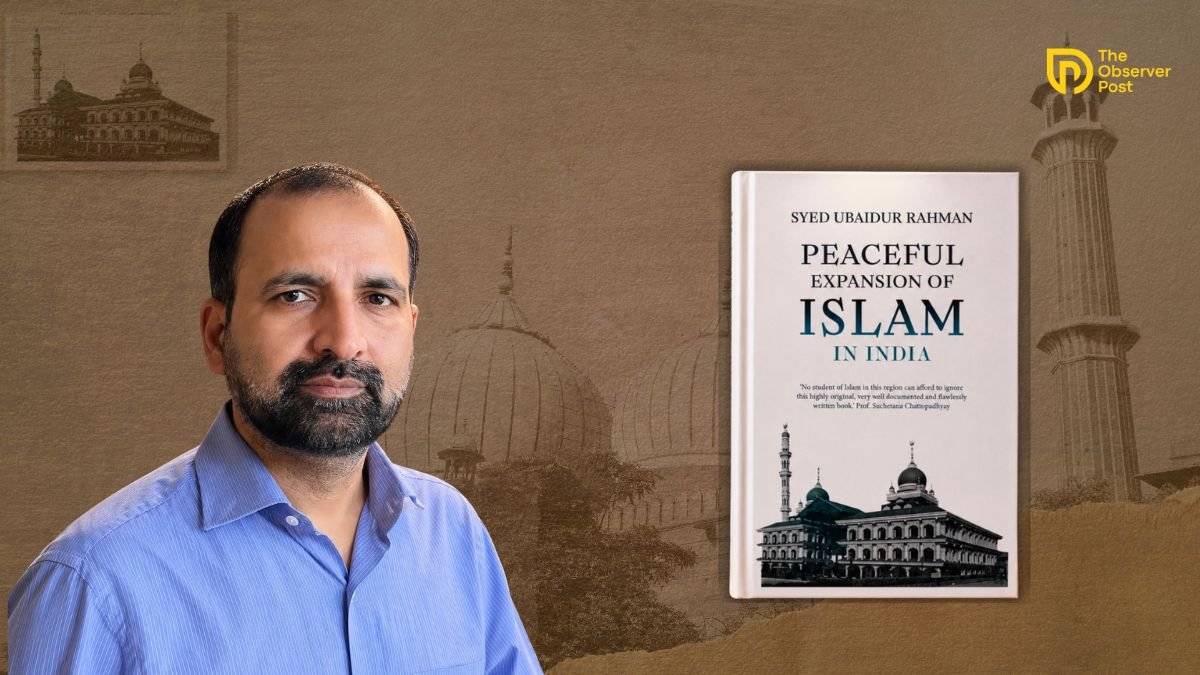
For much of the colonial period, medieval India was interpreted largely through the lens of dynastic succession and military conquest. Subsequent scholarship complicated this picture by demonstrating that the formation of Muslim communities was neither uniform nor reducible to imperial expansion alone. Trade, migration, agrarian development, regional societies, and Sufi networks all emerged as central components of a more complex historical explanation. Yet conquest-centred narratives continue to exert considerable influence in public discourse, often overshadowing the social processes through which Islam became embedded across diverse regions of the subcontinent. It is against this historiographical backdrop that Syed Ubaidur Rahman’s Peaceful Expansion of Islam in India should be read.
Rahman’s book is not simply another account of Islam’s arrival in South Asia; it is an intervention in how that history is interpreted and narrated. Rather than centring political dynasties and military campaigns, he reconstructs the social worlds through which Islam travelled: maritime commerce, merchant diasporas, scholarly exchange, Sufi hospices, and local communities. His central claim is not that conquest was irrelevant, but that peaceful interaction constituted one of the principal historical processes through which Muslim societies became rooted across India.
This intervention builds upon an established historiographical tradition rather than overturning it. Earlier scholarship challenged coercive theories of conversion and redirected attention towards regional societies, ecological change, Sufi institutions, and transregional networks of mobility and exchange. Rahman’s contribution lies less in advancing a fundamentally new thesis than in synthesising these diverse insights into a coherent narrative that foregrounds peaceful interaction as a central explanatory framework. His work is therefore best understood not as a radical reinterpretation of the field but as a thoughtful synthesis that brings decades of social-historical scholarship into a single interpretive account.
The book’s most significant contribution is methodological. Rahman’s approach belongs firmly within the tradition of social history, explaining historical change through networks of exchange, local institutions, and lived social relationships rather than primarily through rulers, dynasties, or state policy. Kings and conquerors certainly appear in his narrative, but they do not dominate it. Instead, merchants crossing the Arabian Sea, Sufi saints establishing local communities, scholars moving between intellectual centres, and families negotiating new social relationships emerge as the principal historical actors. By relocating historical agency from imperial courts to society itself, Rahman challenges explanatory models that privilege warfare and political authority while demonstrating how commerce, mobility, kinship, and everyday interaction shaped religious change over time.

The strengths of this approach, however, also reveal its limitations. A social history must demonstrate not only that these actors mattered but also that they adequately explain broader historical transformations. Rahman’s regional chapters illustrate this tension. Kerala’s long-standing commercial connections with the Indian Ocean world make the case for maritime exchange especially persuasive. Bengal presents a different historical landscape, where agrarian expansion, frontier settlement, political patronage, and Sufi institutions interacted in more complex ways. Kashmir followed yet another trajectory, shaped by Persianate intellectual traditions and local devotional practices. These regional histories convincingly demonstrate diversity, yet they stop short of developing a sustained comparative explanation. Rather than converging into a broader analytical framework, they often remain parallel narratives.
Reading Rahman alongside Richard M. Eaton is particularly illuminating because the two historians seek to answer different, though complementary, questions. Eaton is primarily concerned with the structural conditions that enabled religious change: ecological transformation, frontier expansion, agrarian development, and political authority. Rahman, by contrast, foregrounds the individuals and networks through which these structural processes acquired social meaning. Put differently, Eaton asks why conditions for religious change emerged, whereas Rahman asks who animated those conditions. Together, their work suggests that the formation of Muslim societies cannot be explained solely through either structural transformation or human agency, but through the dynamic relationship between the two.
The breadth of Rahman’s source base is another notable strength. Medieval travel accounts, Arabic and Persian chronicles, colonial scholarship, regional histories, and contemporary academic research are brought into productive conversation. The diversity of evidence enriches the narrative, yet it also raises important methodological questions. Travel narratives, hagiographies, chronicles, ethnographies, and archival records differ substantially in genre, purpose, and evidentiary value. Although Rahman recognises these differences, he devotes relatively little attention to explaining how conflicting forms of evidence are evaluated or how local traditions are critically assessed. A fuller discussion of source criticism would have strengthened the analytical foundations of the book.
The principal historiographical question raised by the book concerns explanation rather than evidence. Rahman convincingly demonstrates that military conquest alone cannot account for the spread of Islam in India. Yet the book occasionally moves between the spread of Islam, the establishment of Muslim communities, and religious conversion as though these were interchangeable processes. Historiographically, however, they are distinct. Merchant settlement, cultural exchange, Islamisation, and conversion unfolded through different mechanisms and at different historical tempos. Peaceful interaction undoubtedly formed an important part of this history, but it cannot, on its own, explain the diversity of religious change across the subcontinent. Greater attention to these distinctions would have strengthened the book’s explanatory framework while avoiding the impression that one master narrative is simply replacing another.
These criticisms, however, should not obscure the book’s broader contribution. Rahman’s greatest achievement lies in recovering dimensions of India’s Islamic past that have often remained peripheral in conquest-centred histories. By foregrounding merchants, scholars, Sufi networks, and local communities, he broadens the field of inquiry and restores agency to historical actors who connected regions through commerce, learning, and everyday social exchange. The result is a richer account of how religious traditions become rooted within particular societies—not simply through political authority, but through long processes of adaptation, negotiation, and cultural interaction. Written in accessible prose while remaining grounded in established scholarship, the book will be valuable to students, general readers, and scholars interested in the social history of South Asia.

Ultimately, Peaceful Expansion of Islam in India should be read not as the final word on Islam’s spread in India but as a significant contribution to an ongoing historiographical conversation. Its greatest achievement is not that it replaces one explanation with another, but that it restores historical plurality to a debate too often reduced to singular narratives. At a moment when definitive historical verdicts have become politically attractive, Rahman’s work reminds us that the past rarely conforms to singular explanations. Its enduring contribution lies in reopening historical inquiry rather than closing it, demonstrating that the historian’s task is not to manufacture certainty but to illuminate complexity.
Sheikh Ayesha Islam is a Delhi-based writer who focuses on art, culture, politics, entertainment, digital discourse and broader social narratives. An alumna of the Department of Educational Studies, Faculty of Education at Jamia Millia Islamia, she holds master’s degrees in Social Work and Early Childhood Development. She can be reached at islamunofficial@gmail.com.
The views expressed in this article are the author’s own and do not necessarily reflect the policy of the platform.