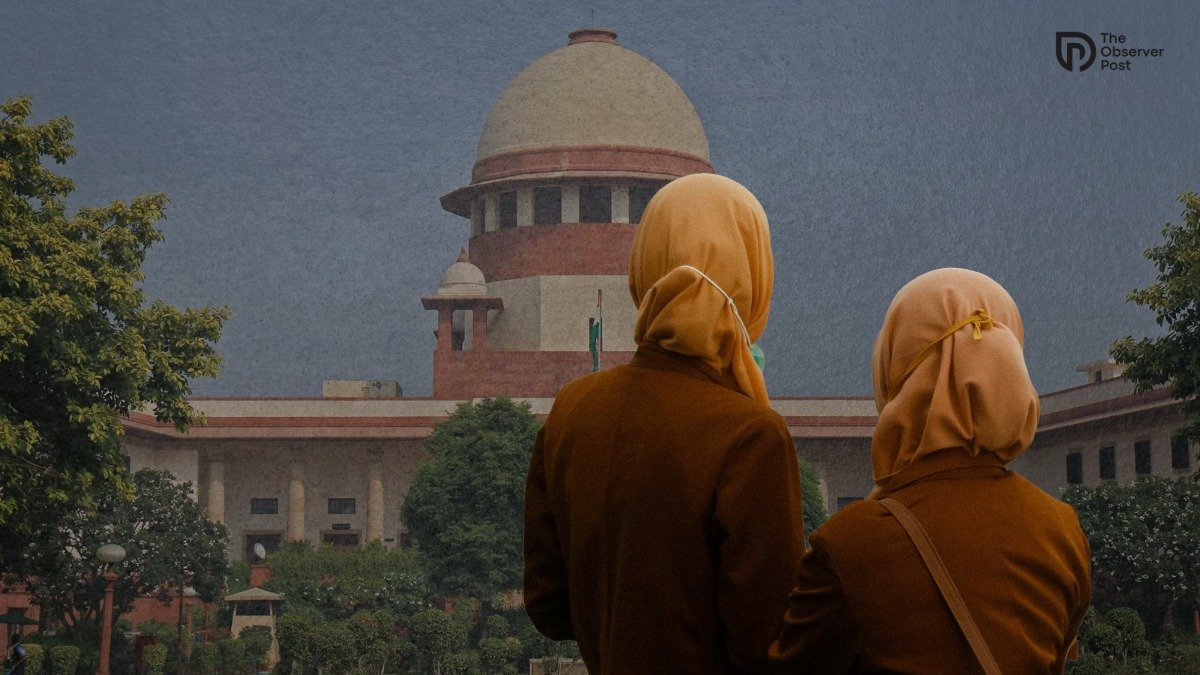
Nearly nine years after the Supreme Court struck down instant triple talaq, the constitutional validity of polygamy under Muslim personal law is once again before the court.
A petition filed by five activists has challenged the legal basis that allows Muslim men to have more than one wife. The petitioners have asked the court to remove the exemption available under Muslim Personal Law and make polygamy punishable under Section 82 of the Bharatiya Nyaya Sanhita (BNS).
The Supreme Court has sought the Centre’s response and has also asked the government to consider legislative measures to abolish polygamy for citizens of all religions.
What does the law currently say?
Section 82 of the BNS makes marrying again while an existing marriage is still in force a criminal offence, punishable by up to seven years in prison. However, the provision does not apply in the same way to Muslim men whose marriages are governed by Muslim Personal Law.
The petitioners are challenging Section 2 of the Muslim Personal Law (Shariat) Application Act, 1937, arguing that the exemption violates the constitutional guarantees of equality and non-discrimination under Articles 14, 15 and 16.

The petitioners have also sought compulsory registration of Muslim marriages to prevent subsequent marriages while an existing marriage continues.
What are the petitioners demanding?
The Bharatiya Muslim Mahila Andolan (BMMA), along with other activists, has sought the criminalisation of polygamy and greater legal safeguards for women in Muslim marriages.
The petitioners argue that the existing framework disproportionately affects women and that the State should ensure that a first wife and her children have priority rights over the matrimonial home if a subsequent marriage is contracted.
They have also called for the codification of Muslim personal law in accordance with constitutional principles of gender equality.
What did the Supreme Court previously decide?
The court has previously dealt with cases involving multiple marriages but has not directly ruled on the constitutional validity of polygamy itself.

In Sarla Mudgal v. Union of India (1995), the Supreme Court held that a Hindu man cannot convert to Islam merely to marry again without dissolving his existing Hindu marriage.
The position was reaffirmed in Lily Thomas v. Union of India (2000).
In Shayara Bano v. Union of India (2017), the Supreme Court struck down instant triple talaq. However, the Constitution Bench did not decide the validity of polygamy or nikah halala.
The two practices subsequently remained subject to separate legal challenges.
Is polygamy an essential part of Islam?
One of the significant constitutional questions is whether polygamy qualifies as an Essential Religious Practice protected under Article 25.

Petitioners have argued that it does not. They have relied, among other things, on Surah An-Nisa (4:3), which permits multiple marriages under certain circumstances but requires justice between wives and directs a man to marry only one if he fears he cannot maintain that standard.
The petitioners contend that polygamy is therefore a conditional permission rather than an essential religious obligation.
The legal debate will also involve the balance between Article 25’s protection of religious freedom and constitutional guarantees of equality, dignity and gender justice.
What about nikah halala?
The broader legal controversy also includes nikah halala, a practice in which a divorced Muslim woman, under certain interpretations, must marry another man and consummate that marriage before she can remarry her former husband.
The Supreme Court had previously indicated that challenges to polygamy and nikah halala could be considered by a Constitution Bench.
The present proceedings could therefore reopen questions that were left unresolved during the 2017 triple talaq judgment.
What could the Supreme Court do?
The court could ultimately determine whether the existing legal framework providing for polygamy is constitutionally valid. It could also examine whether Parliament should enact legislation regulating or prohibiting the practice.