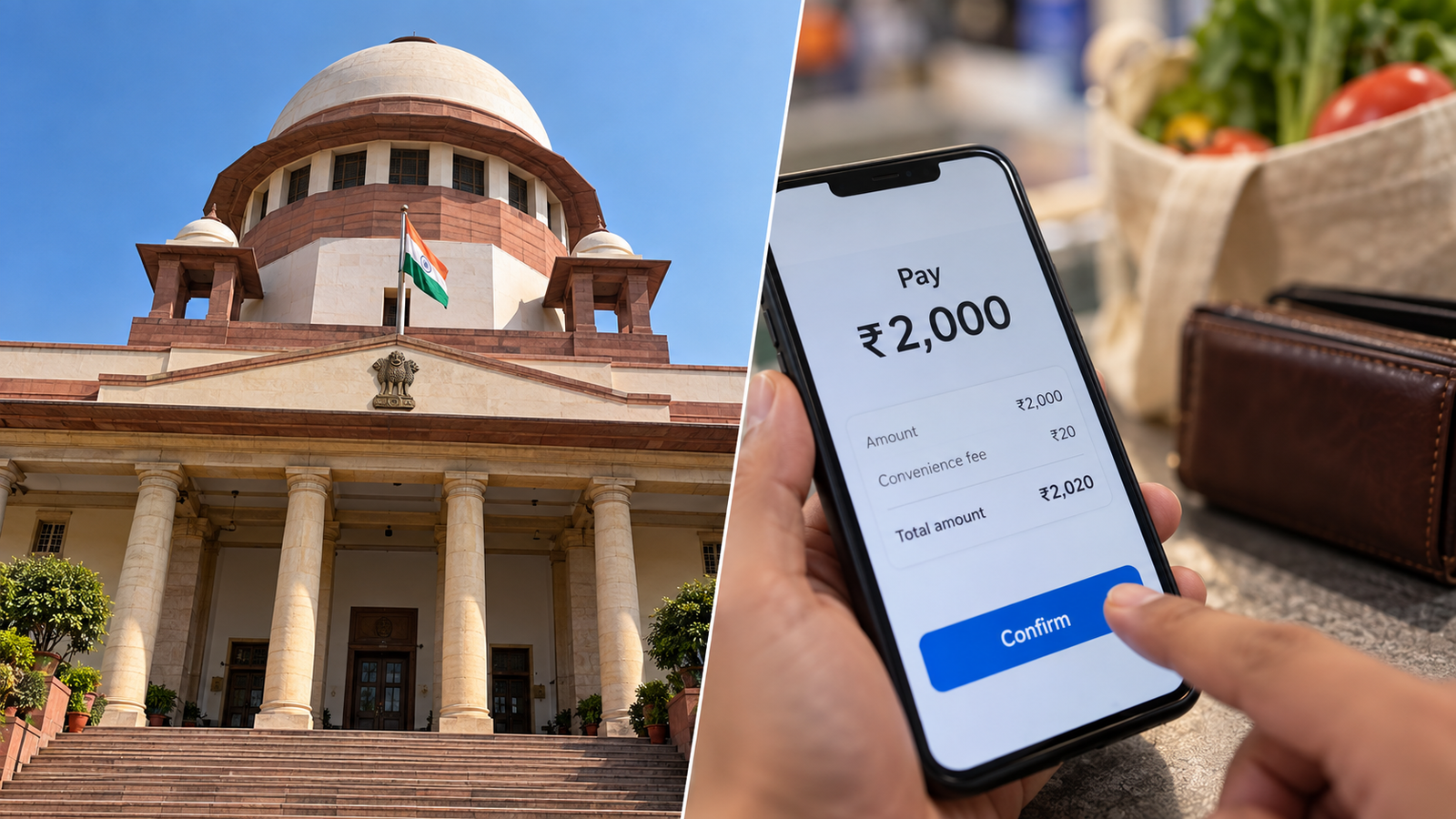
On Monday, Supreme Court will take up a petition that challenges the central government’s decision to charge a fee on certain UPI payments made to merchants above Rs 2,000.
After nearly six years of UPI transactions being completely free, the government has brought in a 0.4 percent Merchant Discount Rate, or MDR, on person-to-merchant transfers over Rs 2,000, effective from October 15. Ordinary person-to-person transfers and smaller payments will remain free of any charge. For larger payments, the fee will be capped at Rs 300 once a transaction crosses Rs 75,000.
Certain low-margin sectors, including railways, telecom, insurance, fuel and farm input suppliers, will instead pay a flat fee of Rs 5 on transactions above Rs 2,000. Payments made toward mutual funds, securities and through brokers and dealers will attract a smaller 0.02 percent fee, also capped at Rs 300. Person-to-person transfers, which the report says account for 37 percent of UPI’s transaction volume and 70 percent of its transaction value, will continue to remain free regardless of the amount involved.
The case is listed to come up before a bench led by Chief Justice of India Surya Kant, along with Justices Joymalya Bagchi and V. Mohana. The petition was filed by advocate Anjan Datta, who has challenged both the government’s September 14 notification and the fee structure announced the following day, which is due to take effect from October 15.
The petition argues that the new charge was brought in without proper legal safeguards, transparency or any public consultation. It also questions the constitutional validity of an amended provision of the Payment and Settlement Systems Act, 2007, arguing that it gives the government unchecked discretion to decide which digital payment methods should be exempt from charges.

The plea asks the court to rule that no such fee can be imposed simply through a press statement or a set of FAQs, without a proper, legally authorised and published order backing it. It also draws attention to what it calls an inconsistency in the government’s approach, since RuPay debit card transactions continue to enjoy fee-free status with no upper limit, unlike UPI merchant payments.
According to the petition, the new fee structure is arbitrary and unfairly targets certain merchants, particularly small businesses operating on thin margins. It also raises concerns that the cost could eventually be passed on to ordinary consumers, and that some users could be pushed away from digital payments altogether.
The petitioner has asked the court to either strike down or put on hold the fee structure as it applies to UPI transactions above Rs 2,000. As an alternative, the plea asks the court to direct the government to reconsider the entire framework only after holding proper consultations, publishing supporting data and studies, and building in specific protections for micro and small enterprises.
It further asks that any future decision on which transactions should be charged take into account factors such as a merchant’s turnover, official MSME status, actual profit margins, location and ability to absorb the cost, rather than applying a blanket rule without any supporting evidence. The Centre and the Reserve Bank of India have both been named as respondents in the case.