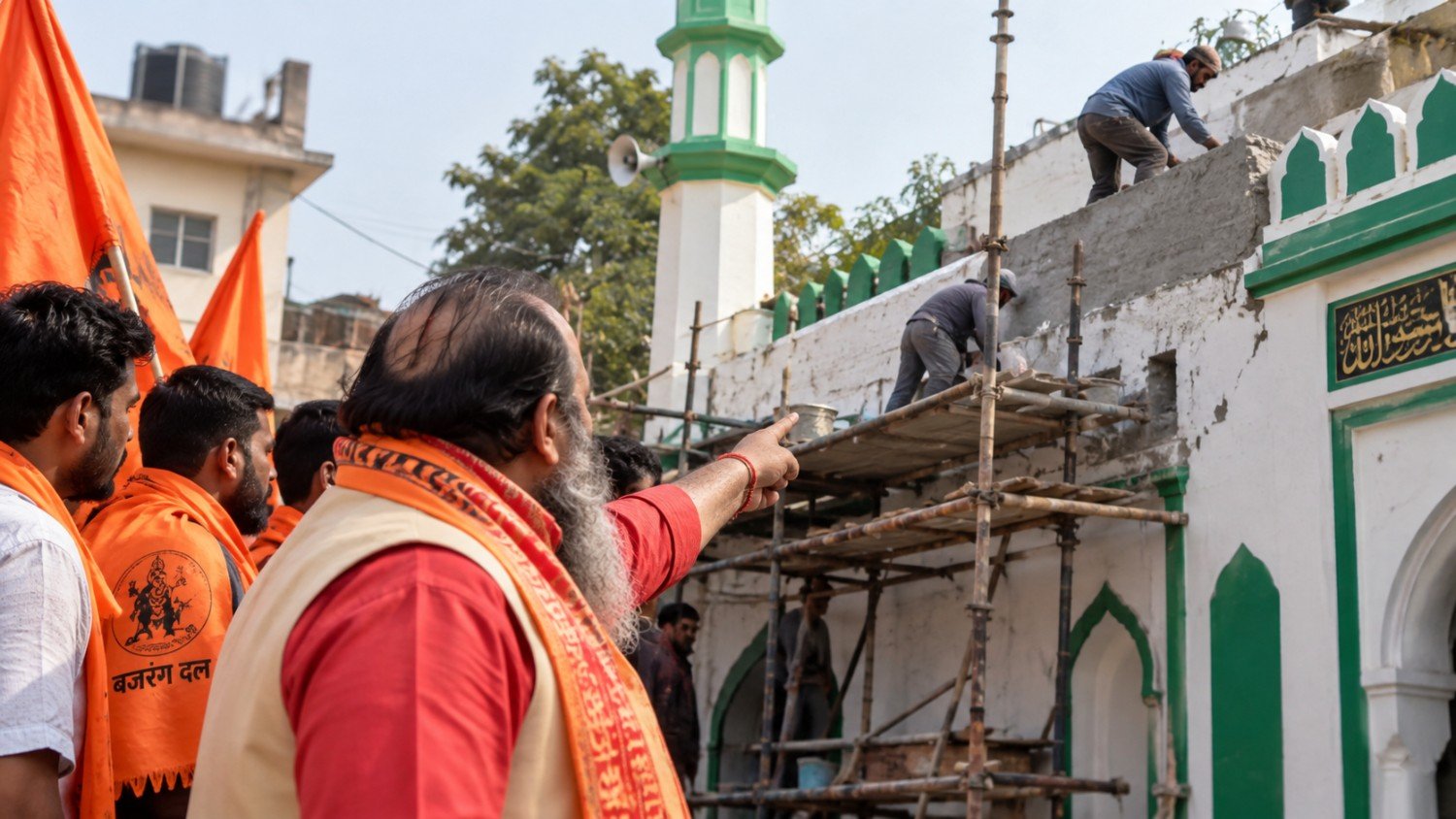
Members of the Bajrang Dal stopped repair work at a mosque in Dehradun’s Sevla Kalan area on the Shimla Bypass this week, alleging that the building is illegal and has encroached on the road, and threatened to have it sealed.
Officials from the Mussoorie Dehradun Development Authority (MDDA), the police and the municipal corporation reached the spot while the work was being halted by Bajrang Dal members, but did not step in, according to local reports.
Grouting work was under way on the mosque’s third floor when a group led by Vikas Verma arrived and forced the workers to stop. Verma and his associates claimed that the structure encroaches on the road and obstructs people using it, and that it stands in a Hindu-majority locality. He demanded an investigation into the entire property, and the mosque’s immediate demolition if any part of it is found to be illegal.
However, representatives from the mosque committee reject these claims. Naeem Qureshi, president of the Muslim Seva Sangathan, and its vice-president Aqib Qureshi said the work was routine maintenance to stop rainwater leaking through the roof of the third floor, and that no new construction was being carried out.
Dehradun, Uttarakhand: Bajrang Dal Stops Grouting Work at Mosque in Sevla Kalan
— Haider Khan (@Haiderker) October 29, 2026
In Sevla Kalan, Dehradun, Bajrang Dal president Vikas Verma and other activists arrived at a mosque where grouting work was underway, created a commotion and forced the work to stop. pic.twitter.com/Uo3JEDTcx2
“The mosque is legal and has been built in accordance with the rules,” they said, dismissing the allegations as false.
The episode follows a series of actions against mosques in and around Dehradun in recent months.
On June 2, the MDDA sealed a mosque in Thano village after a Hindutva group, led by Kali Sena’s Bhupesh Joshi, demanded that there should be no mosque in front of a nearby temple.
The imam, Yasir Arafat, said the whole mosque was sealed because one room, built by the state’s minority welfare department, lacked a sanctioned map, and that the mosque has registered land and documents.
Local Muslims said it had functioned since 1978. IndiaTomorrow described it as the fifth mosque in the area to be shut. After the sealing, members of Kali Sena also held a havan (Hindu rituals) outside the building.
Uttarakhand has also moved to tighten control over religious institutions in recent months.
The state has repealed its madrasa law, and set up a single authority to supervise all minority-run schools, and is now drafting a religious education syllabus for them.
Critics say these steps, together with campaigns by Hindutva groups, are increasing pressure on Muslim institutions in the state, while the government says its aim is regulation and uniform standards.