Ayesha Afnan
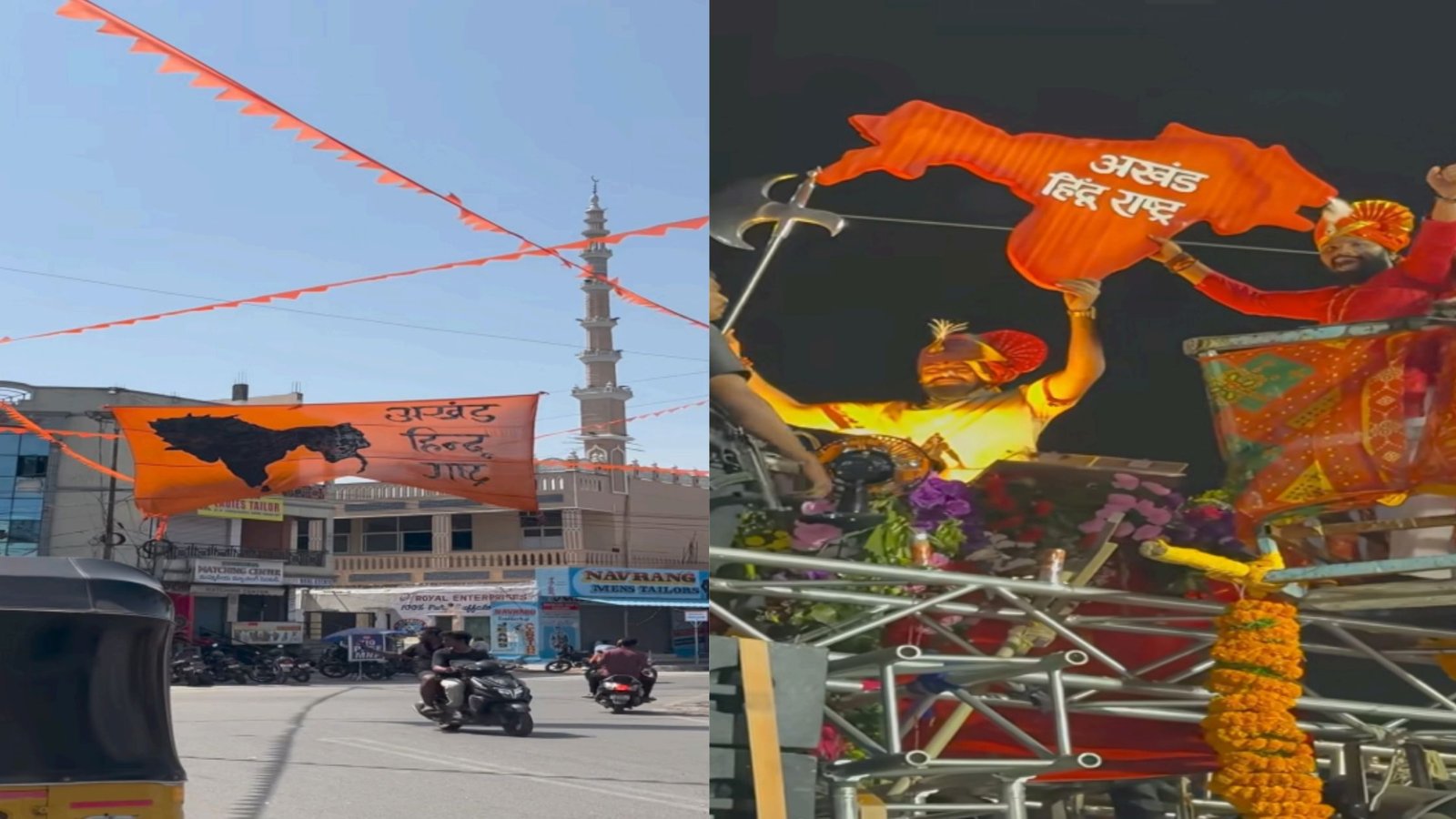
On the roads of Malkajgiri, Hyderabad, the appearance of “Akhand Hindu Rashtra” banners reflects the growing public visibility of calls for a Hindu nation in the region. The banners emerged in the aftermath of a March 29 public event where T. Raja Singh administered an oath. Participants who gathered at the event repeated the oath after him, publicly affirming their commitment to objectives such as protecting India, combating so-called “love jihad,” engaging in cow protection activities, and working towards the establishment of a “Hindu Rashtra.” The widespread display of such banners indicates how these calls have moved beyond speeches and public gatherings into everyday public spaces.
Attendees took an oath led by T. Raja Singh, pledging support for the establishment of a “Hindu Rashtra.”
Ram Navami Processions and Public Messaging
The messaging had already been visible days earlier. On March 27, during the Sri Rama Navami Shobha Yatra led by T. Raja Singh, “Akhand Hindu Rashtra” banners were prominently displayed throughout the procession. The banners, carrying the slogan of a united Hindu nation, formed a notable part of the event’s visual landscape, signalling the continued promotion of the Hindu Rashtra agenda during religious and political mobilisations in the city.
T. Raja Singh’s Continued Hindu Rashtra Campaign
The promotion of a Hindu Rashtra has also featured prominently in the public activities of T. Raja Singh in recent years. In 2023, he addressed multiple rallies in Maharashtra, where he stated that India would be declared an “Akhand Hindu Rashtra” by 2026, speeches that later became the subject of several police complaints. In 2024, he continued campaigning on the issue, including at a rally in Solapur, where he called for the election of “staunch Hindu MPs” to advance the Hindu Rashtra agenda. In 2026, he further reiterated these demands while addressing a Hindu Rashtra awareness meeting in Ponda, Goa, reflecting the continued promotion of the idea across different states.
Hindu Rashtra Narratives in Digital Spaces
The promotion of Hindu Rashtra narratives has also extended into digital spaces. A Telugu song published on YouTube on June 16, 2021, which has accumulated over 1.1 million views and 14,000 likes, contains lyrics advocating the saffronisation of Hyderabad’s Charminar. Between timestamps 3:21 and 3:37, the song states: “Saffron flags will be hoisted on the four minarets of Charminar, and if anyone comes in between, there will be no trace of him.”
The same lyrics recently resurfaced on social media, with Hindutva-affiliated Instagram handles sharing a video featuring the excerpt on February 24. The post garnered approximately 1.3 million views and 189,000 likes, indicating the continued circulation and popularity of such messaging online.
Hindu Sammelans and Anti-Muslim Messaging
Such rhetoric has not been limited to a single event. In several other Hindu Sammelan speeches circulated online, Sri Sri Shankar Swamiji, the State President of the Telangana Sadhu Parishad, shared a reel on Instagram on May 4 with his 53,000-plus followers, featuring a speech delivered at a Hindu Sammelan. In the video, he was seen making remarks directed at Muslims, stating that they should either leave India or declare their allegiance by saying “Vande Mataram” and “Jai Shri Ram.” The clip was subsequently circulated online, contributing to the wider dissemination of exclusionary and polarising messaging.
He also raised fears about Rohingya refugees, made Islamophobic remarks, and advocated for the “establishment of a Hindu Rashtra” in his other sammelans, which were later posted on his Instagram handle. Instagram accounts associated with Hindu Sammelan events frequently amplify similar content, often urging Hindus to support political leaders who can help establish a Hindu Rashtra.
Sadhvi Prachi’s Speech in Hyderabad
A similar pattern was visible on May 24 in Feelkhana, Hyderabad, where a Hindu Sammelan was organised to commemorate the centenary celebrations of the RSS. During the event, Sadhvi Prachi delivered a speech containing anti-Muslim remarks, referring to Muslims as “Jihadi,” “Miya,” and “topiwale.” She urged Hindus to invest in steel rather than gold, claiming it would help protect their homes from “jihadis.” She also warned of an alleged decline in the Hindu population, called on Hindus to increase their numbers, and claimed that failure to do so would eventually result in demands to convert to Islam or face violence.
The speech concluded with a call for India to be declared a Hindu Rashtra, further illustrating how Hindu Sammelans are being used as platforms to promote Hindu Rashtra advocacy alongside narratives portraying Muslims as a threat.
Social Media Reels and Symbolic Displays
Apart from this song, social media platforms have also seen a surge in reels featuring saffron flags displayed near mosques across Telangana. Many of these videos use the lyrics, “Vande Mataram kehna hoga, nahi to yahan se jana hoga” (“You must say Vande Mataram, otherwise you will have to leave this place”), combining religious symbolism with exclusionary messaging.
A reel posted by the Instagram account @crazy_l_over showed the hoisting of a saffron flag near a mosque in Kollampally, reflecting the growing use of mosques as symbolic backdrops in social media content associated with Hindu Rashtra narratives.
Religious Processions and Symbolic Acts
Similar symbolism has also appeared during public processions. During a Ram Navami procession in Hyderabad’s Begum Bazaar led by T. Raja Singh, a child was seen symbolically shooting an arrow toward a mosque as the procession passed through the area.
The circulation of such imagery, both online and offline, reflects how Hindu Rashtra narratives are increasingly being disseminated through social media content, religious processions, and public displays in Telangana.