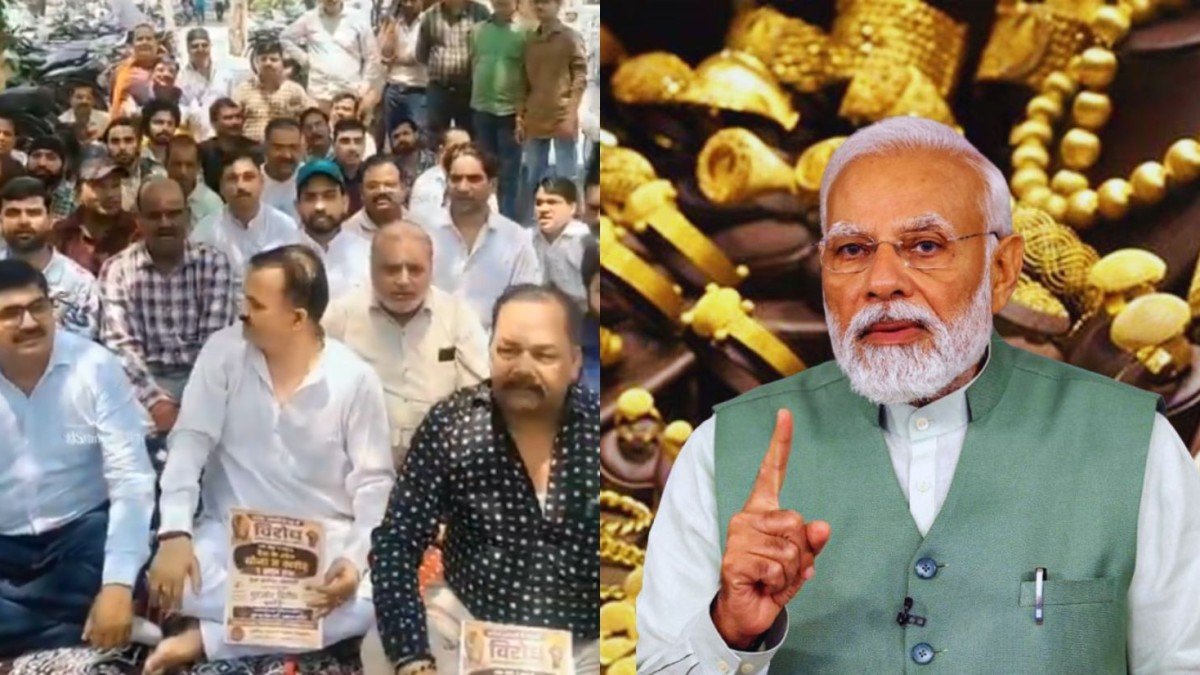
Jewellery traders and workers associated with Lucknow’s sarafa industry staged a protest in Ashiana on Monday after Prime Minister Narendra Modi appealed to citizens to avoid buying gold and overseas travel for one year in order to save foreign exchange amid the ongoing West Asia crisis.
The protest was organised by the Lucknow Mahanagar Sarafa Association and other bullion trader groups, who claimed the Prime Minister’s remarks could severely affect the traditional jewellery business and the livelihoods of thousands of workers linked to the sector.
Traders gathered at Powerhouse crossing in Ashiana and raised slogans against the appeal. Police personnel were deployed at the site, though the demonstration remained peaceful.
“How Will Workers Survive?” Ask Traders
According to trader associations, Lucknow has nearly 6,000 jewellery and sarafa establishments, directly and indirectly supporting thousands of families through craftsmanship, polishing, designing, transport and related work.
Association president Manish Kumar Varma said the sector was already struggling due to rising gold prices and weak demand.
“If people stop purchasing gold, how will jewellers and their employees survive? Thousands of workers depend on this trade. Will the government provide salaries if business collapses?” Varma asked during the protest.
Traders argued that gold in India is not merely a luxury item but also an important household investment and a form of financial security, especially during difficult economic times.
Small Traders Fear Bigger Losses
General secretary of the Chowk Sarafa Association, Vinod Maheshwari, said the Prime Minister’s appeal could hit small and medium traders the hardest.
“This sector supports artisans, craftsmen, polish workers, transporters and small designers. If market sentiment weakens, medium and small traders will slowly disappear,” he said.
Several traders also pointed out that central banks and governments around the world continue to hold large gold reserves, arguing that gold remains financially and strategically important globally.
PM Modi’s Appeal Amid West Asia Crisis
Speaking at a BJP event in Secunderabad, Prime Minister Modi had urged people to reduce fuel consumption, revive work-from-home practices, avoid unnecessary foreign travel and postpone non-essential gold purchases for one year to help conserve India’s foreign exchange reserves.
He said the country must act responsibly amid global economic disruptions and rising prices caused by international conflicts.
“Patriotism is not only about sacrificing one’s life for the country, but also about fulfilling responsibilities during difficult times,” Modi said.
Mixed Reactions from Industry
While traders criticised the remarks, some industry experts supported the Prime Minister’s call. Representatives from the bullion sector said India remains heavily dependent on gold imports, which increase pressure on foreign exchange reserves and the rupee.
However, protesting traders insisted that instead of discouraging purchases, the government should strengthen policies like gold monetisation schemes to reduce import dependency while protecting domestic businesses.
The associations submitted a memorandum to authorities demanding reconsideration of the appeal and warning that any major decline in gold demand could affect lakhs of workers connected to India’s jewellery industry.