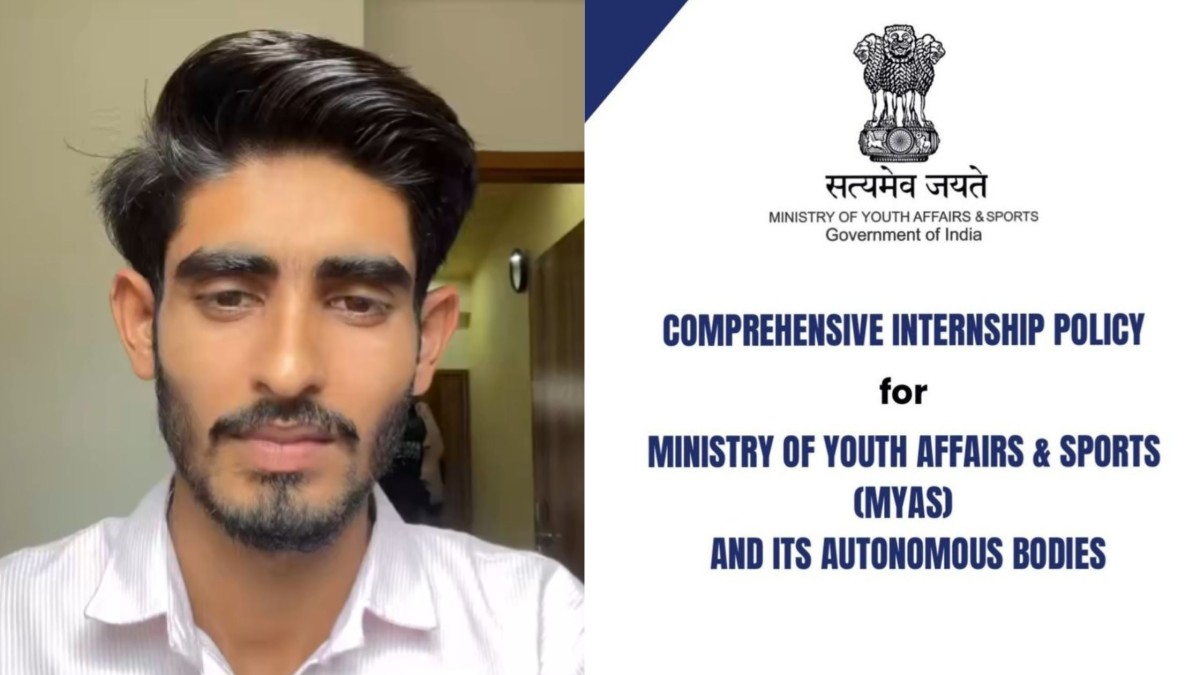
A postgraduate pharmacy student from Uttar Pradesh has alleged that he was denied an internship opportunity at a government laboratory under the Ministry of Youth Affairs and Sports on religious grounds, despite meeting all eligibility criteria.
Shan Mohammad, a final-year M.Pharm (Pharmacology) student from Bulandshahr, claimed that he was abruptly rejected within minutes of appearing for an online interview at the National Dope Testing Laboratory (NDTL), a key anti-doping agency under the ministry.
According to Shan, he had received a formal selection email on March 20 after qualifying the initial screening round for the six-month internship programme, which carried a monthly stipend of ₹20,000. The interview was scheduled for March 30 at around 12 PM.
“Within 2–3 minutes of joining the interview, I was asked my name. After that, the interviewer told me I was not suitable and asked me to leave,” Mohammad alleged. “There were no questions about my qualifications or skills.”
He further claimed that the interviewer’s response appeared dismissive and immediate after hearing his name, leaving him “dazed and shaken.”

According to his account, Shan was among 22 shortlisted candidates, and the only Muslim applicant selected for the interview stage.
The six-month-long internship was not just another line for his résumé. For Shan, it was validation of his years of effort, his family’s financial struggles, and his academic discipline.
Given his specialization in pharmacology—a field directly aligned with anti-doping research—Shan believed he was well-prepared.
“I knew the subject. My field matched the work they were doing,” he recalls.
‘You Are Not Suitable’
But what unfolded in the interview, he says, left him shaken.
Shan says that within minutes of joining the online interview, he was asked only his name and field of study. The interaction, he claims, lasted no more than 2–3 minutes.
“After hearing my name, the interviewer told me, ‘You are not suitable for this role. You may find opportunities elsewhere. This is not for you. You may leave,” he says.
There were no technical questions. No discussion of qualifications. No assessment of skills.
The abruptness of the exchange, Shan says, left him “nervous” for a moment.
When Shan sought clarification, he says he was told that his field was “not interlinked” with the internship.
“I tried to explain that Pharmacology is fundamentally connected to drug analysis and doping control, but I was not given a fair opportunity to present my case,” he added.
He claims he sensed discomfort and a shift in tone from the interviewer after introducing himself, though he acknowledges he cannot definitively explain the reason.
Confidence Turned into Self-Doubt
For a student who had cleared initial screening and received a formal interview call, the experience has been difficult to process.
“Why was I not asked anything about my knowledge?” he asks. “I was prepared. I had worked for this.”
The psychological impact of the incident, he shares, has been significant on him. What began as a moment of achievement quickly turned into self-doubt.
Shan later shared screenshots of his selection email and recorded a video describing the incident, posting it on social media.
He wrote that the official eligibility criteria mentioned M.Pharm without restricting specialisations.
“As per the official eligibility criteria, I am fully qualified, being a Master’s student in Pharmacology—a field directly related to drugs, their effects, and analysis, which aligns with anti-doping work,” he reasoned through a LinkedIn post.
Shan concludes, however, that the interview for him did not proceed as expected.
Questions Over ‘Transparency’
The experience, Shan says, has left him questioning the process rather than just the outcome.
“My concern is not just about selection, but about transparency in the process. Every candidate deserves a fair chance to present themselves,” he said, expressing anguish in a social media post.
“Shan says the official eligibility clearly mentioned M.Pharm without restricting specific specialisations. That’s why this situation feels unclear and unfair to me,” he pointed.
He stressed that his intent is not to seek sympathy but accountability, adding that he hopes no other student from this field faces a similar situation in future.
“I am sharing this experience to bring attention to a serious concern and to request transparency from the concerned authorities,” he wrote, stressing that he is open to guidance on addressing such situations constructively.
From Aspiration to ‘Rejection’

For students from rural backgrounds, opportunities like these carry significance beyond academic progression—they represent mobility, validation, and hope.
That is why the abrupt end to what he believed was a promising opportunity left him shaken.
For Shan Mohammad, an aspiring research scholar from Ahmedpur Tanda village in Bulandshahr, Uttar Pradesh, education was never just about personal ambition—it was a responsibility.
Shan is the eldest son in his family. His father works as a farmer while also crafting household almirahs to supplement the family’s income, and his mother is a homemaker.
Like many first-generation learners, Shan carried the weight of expectations—not only to succeed, but to uplift his family.
“I have always felt responsible,” he says.
After completing his Bachelor of Pharmacy in 2024 from AKTU, Shan enrolled in a Master’s programme in Pharmacology in Greater Noida.
His academic credentials include certifications such as GCP-ICH, participation in an international conference at Amity University, and selection for other Central government-linked internships.
Despite the current setback, Shan shares that he has also secured another government internship with the Indian Pharmacopoeia Commission (IPC), which he is now preparing to join.
Past Instances of Discrimination
For many young, educated individuals from minority and rural backgrounds, such experiences can leave a lasting impact on confidence and trust in institutional processes.

Over the years, several reports have highlighted allegations of candidates being denied opportunities—either after their religious identity became known or despite strong academic credentials.
While the Indian Constitution guarantees equality before the law (Article 14), prohibits discrimination on religious grounds (Article 15), and ensures equal opportunity in public employment (Article 16), concerns around bias in recruitment continue to surface.
Shan’s claims, however, remain unverified, with no official response yet from the National Dope Testing Laboratory (NDTL) or the Ministry of Youth Affairs and Sports addressing the alleged irregularities in the interview process.
As debates around inclusion and equal opportunity continue, Shan’s account adds another voice to a growing conversation:
Not just about selection, but whether merit alone is enough to secure opportunities in this country, getting increasingly divided along religious lines, anymore?