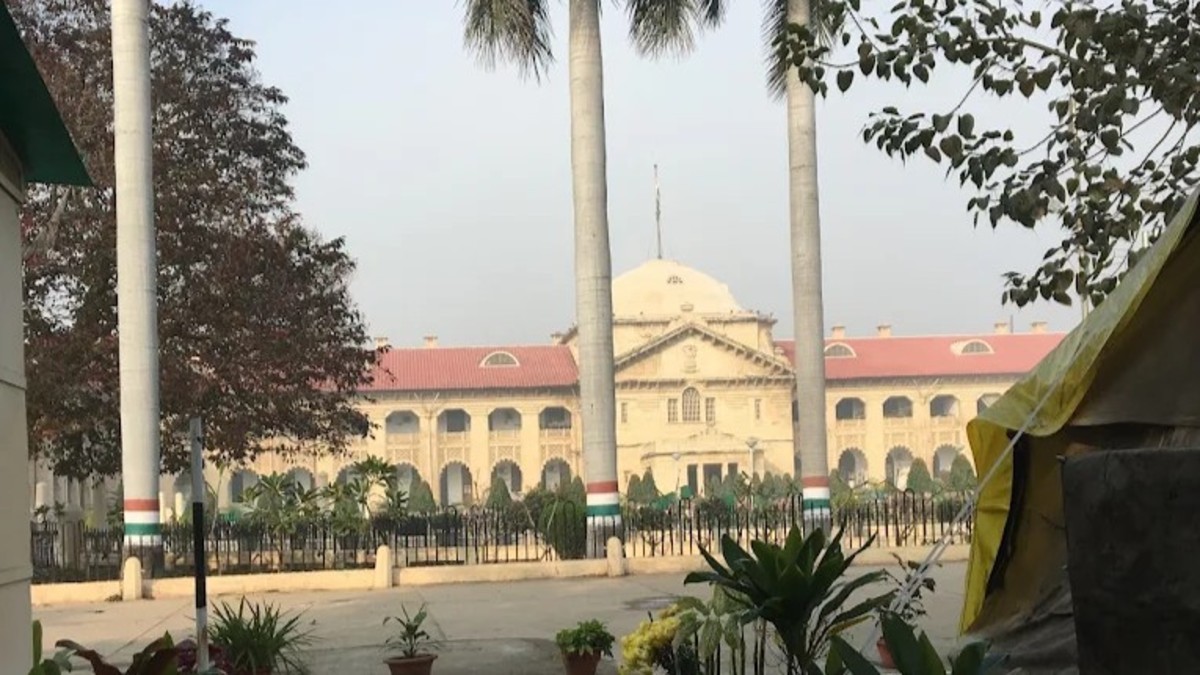
A division bench of the Allahabad High Court has delivered separate interim observations after differing sharply on the role and functioning of human rights bodies in India, particularly the National Human Rights Commission (NHRC).
The case was heard in a petition filed by the Teachers Association Madaris Arabia, which challenged NHRC orders related to an investigation into aided madrasas in Uttar Pradesh.
While both judges were examining the same matter, Justice Atul Sreedharan and Justice Vivek Saran expressed contrasting views on how far human rights commissions should intervene in such cases.
“No Action in Lynching Cases,” Says Justice Sreedharan
Justice Atul Sreedharan raised strong concerns about what he described as a lack of action by human rights bodies in cases involving violence against minorities.
He said the commissions appear to be focusing on matters beyond their core mandate while ignoring serious incidents.
“Instead of taking suo motu cognizance in which members of the Muslim community are attacked and at times lynched, the Human Rights Commissions are seen dabbling in matters that prima facie do not concern them,” he observed.
He further said the court was not aware of any instance where the NHRC had acted on its own in cases involving vigilante violence or communal harassment.
Referring to social tensions, he added that even ordinary interactions between people of different communities can sometimes become “fearful,” noting that such issues deserve urgent institutional attention.
“In such cases, no instance has been placed before this Court whether the NHRC or State Commission took suo motu cognizance,” he said, adding that many such matters could instead be addressed by High Courts under Article 226 of the Constitution.
Justice Saran Disagrees, Calls for Judicial Balance
However, Justice Vivek Saran disagreed with these broader observations and recorded a separate order.
“I do not agree with the observations made in paragraph nos. 6 and 7,” he said, clearly distancing himself from Justice Sreedharan’s comments.
He stressed that when courts make strong observations affecting institutions like the NHRC, all parties should be given a proper hearing.
“In the absence of the parties, no adverse observations were required,” Justice Saran noted, adding that judicial restraint is important at the interim stage.
He also pointed out that while courts can pass orders even without all parties present, in this case it would have been “appropriate” to hear everyone before making sweeping remarks.
Madrasa Case at the Centre of Dispute
The matter before the court relates to NHRC directions ordering an investigation by the Economic Offences Wing (EOW) into allegations against 558 aided madrasas in Uttar Pradesh.
The NHRC complaint had alleged irregularities, including recruitment of unqualified teachers and misuse of government grants. The petitioners challenged the NHRC’s jurisdiction and the timing of the inquiry.
Earlier, the High Court had already stayed the NHRC order, and the matter is scheduled for further hearing on May 11, 2026.