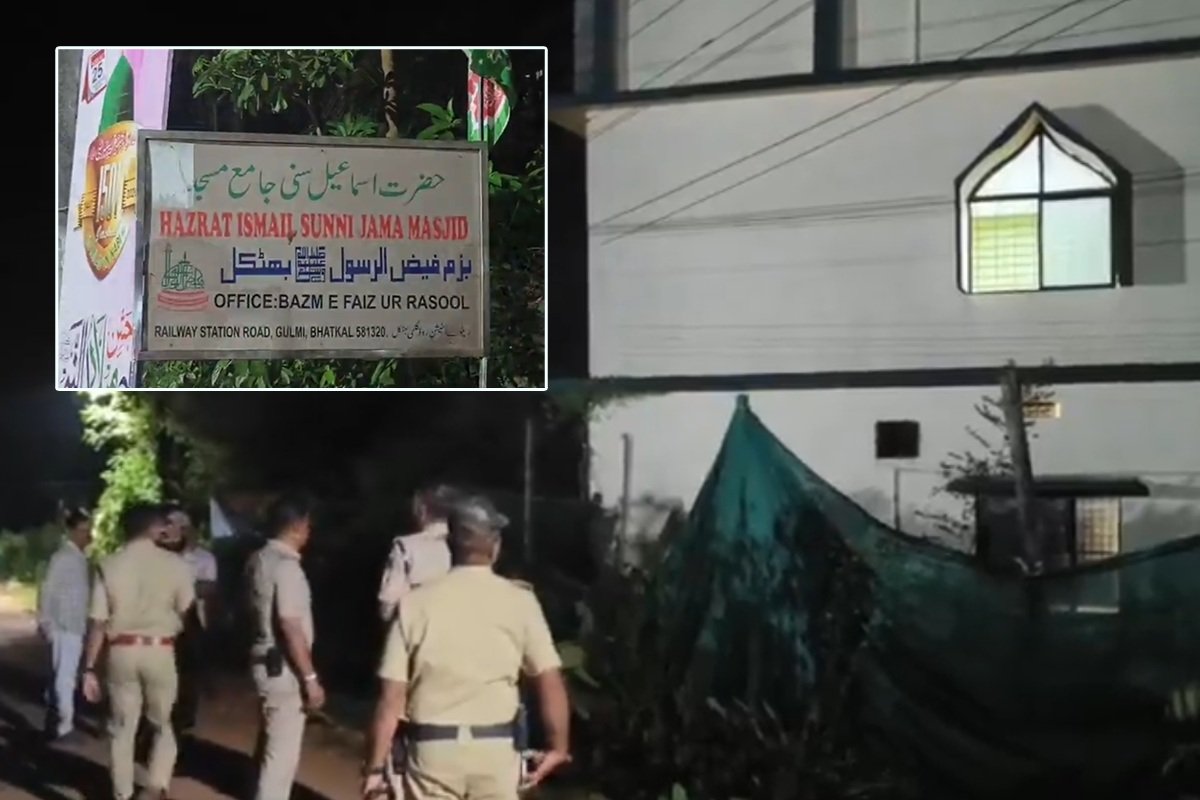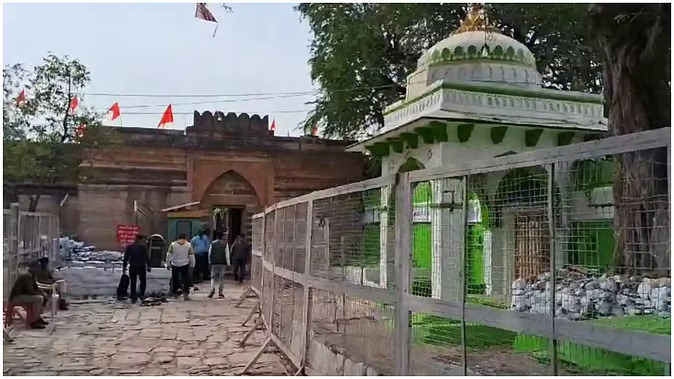
The Madhya Pradesh High Court on Friday declared that the disputed Bhojshala-Kamal Maula complex in Dhar is a temple dedicated to Goddess Saraswati and ended the arrangement that allowed Muslims to offer Friday namaz at the site.
A division bench of Justice Vijay Kumar Shukla and Justice Alok Awasthi ruled in favour of Hindu petitioners, saying historical records and archaeological material indicate that Bhojshala was a centre of Sanskrit learning linked to Raja Bhoj and housed a temple of Goddess Vagdevi Saraswati.
“We have noted the continuity of Hindu worship at the site,” the court observed, adding that historical literature establishes Bhojshala as a Sanskrit learning centre associated with Raja Bhoj.
The court also quashed parts of a 2003 order issued by the Archaeological Survey of India (ASI), under which Hindus were allowed to perform puja on Tuesdays and Muslims were permitted to offer namaz on Fridays at the Kamal Maula Mosque section of the complex.
Court Suggests Alternate Land for Mosque
While recognising Bhojshala as a temple, the High Court said the Muslim community could approach the state government for allotment of separate land in Dhar district for the construction of a mosque.
“In order to secure the religious rights of the Muslim community and to ensure complete justice between the parties, the state may consider allotment of suitable and permanent land in Dhar district for construction of a mosque,” the court said.
The bench directed the ASI to continue supervising the preservation and conservation of the protected monument. It also asked the Centre to consider representations seeking the return of the idol of Goddess Saraswati, currently believed to be in a museum in London.
“The Government of India may consider their representations to bring back the Pratima of Goddess Saraswati from the London Museum and re-establish the same within the complex,” the order stated.
Muslim Side to Challenge Verdict in Supreme Court
The Muslim side strongly opposed the ruling and announced plans to challenge it in the Supreme Court of India.
Dhar Shahar Qazi Waqar Sadiq said, “We will review the decision that has been made against us. We will challenge the verdict in the Supreme Court.”
Advocate Ashhar Warsi, representing the Muslim side, alleged that the ASI survey report was biased and ignored several documents presented by them.
“We are going to approach the Supreme Court. Government documents given by us were not considered by the court. During the survey, ASI did not consider our claims,” Warsi said.
He also maintained that namaz had been offered at the site for centuries and argued that the 2003 arrangement was meant to continue existing prayers, not introduce a new practice.
Owaisi Compares Verdict to Babri Masjid Judgment
Asaduddin Owaisi, president of All India Majlis-e-Ittehadul Muslimeen (AIMIM), criticised the judgment and compared it to the Babri Masjid verdict.
“We hope the Supreme Court will set this right and overturn this order. Glaring similarities with the Babri Masjid judgment,” Owaisi wrote on X.
The Bhojshala dispute has remained one of central India’s most sensitive religious and legal battles for decades. Hindus consider the site an ancient Saraswati temple built during the rule of Raja Bhoj, while Muslims regard it as the Kamal Maula Mosque.
The High Court’s verdict came after months of hearings and a detailed ASI scientific survey conducted in 2024. The ASI report had claimed that a large temple-like structure existed at the site before the mosque structure was built.