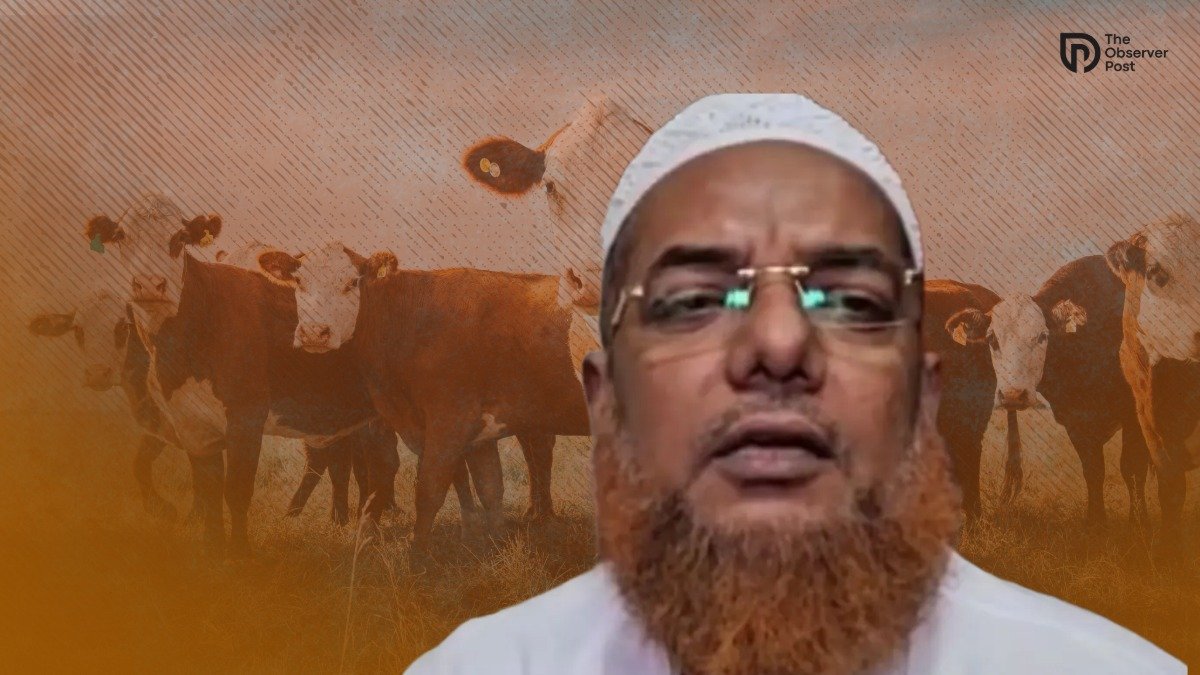
The Imam of Kolkata’s historic Nakhoda Mosque, Maulana Mohammad Shafiq Qasmi, has appealed to Muslims to avoid cow sacrifice, saying it hurts the sentiments of Hindus and that social harmony should be protected in a diverse country.
Speaking in response to new animal slaughter regulations introduced by the West Bengal government, Qasmi said Muslims should act with sensitivity toward other communities.
“We appeal to our Muslim brothers not to sacrifice cows, as it hurts the sentiments of our Hindu brothers,” Qasmi said, adding that goats could be sacrificed instead.
New Slaughter Guidelines Spark Discussion
The remarks come days after the West Bengal government introduced fresh guidelines on animal slaughter. Under the new rules, animals cannot be slaughtered without a “fit certificate” issued by authorities. Officials will examine the age and physical condition of animals, including bulls, bullocks, cows, calves, and buffaloes, before granting permission.
As per the guidelines, only animals above 14 years of age or those permanently incapacitated due to injury, deformity, old age, or incurable disease can be approved for slaughter.
Qasmi said the stricter enforcement of the law has made animal slaughter difficult in many areas due to the lack of local infrastructure.
“The government should first make arrangements for all these things, build slaughterhouses in every area, and ensure veterinary surgeons are available in every market,” he said.
‘Declare Cow National Animal If Ban Is Intended’
The cleric said that if authorities are unable to provide the required facilities, the government should take a clear position.
“If the government cannot provide the required infrastructure, then it should declare the cow the national animal and impose a complete ban on cow slaughter and beef exports,” Qasmi said.
Referring to the West Bengal Animal Slaughter Control Act, he noted that the law has existed since 1950 and is now being implemented more strictly.
“All previous governments gave Muslims freedom, but they never provided a permanent solution to the problem. This government is simply implementing the law strictly,” he added.
Loudspeaker Rules and Mosque Concerns
Qasmi also spoke about restrictions on loudspeakers at religious places, saying the rules are based on Pollution Control Board norms framed in the 1990s and later upheld by the Supreme Court.
He explained that permitted sound limits vary according to zones, ranging from industrial and commercial areas to residential and silence zones.
At the same time, the Imam expressed concern over reports from some rural areas where police allegedly removed microphones from mosques.
“There is no guideline to completely remove microphones,” he said, urging mosque committees to cooperate with authorities and ensure loudspeakers remain within permitted sound limits.