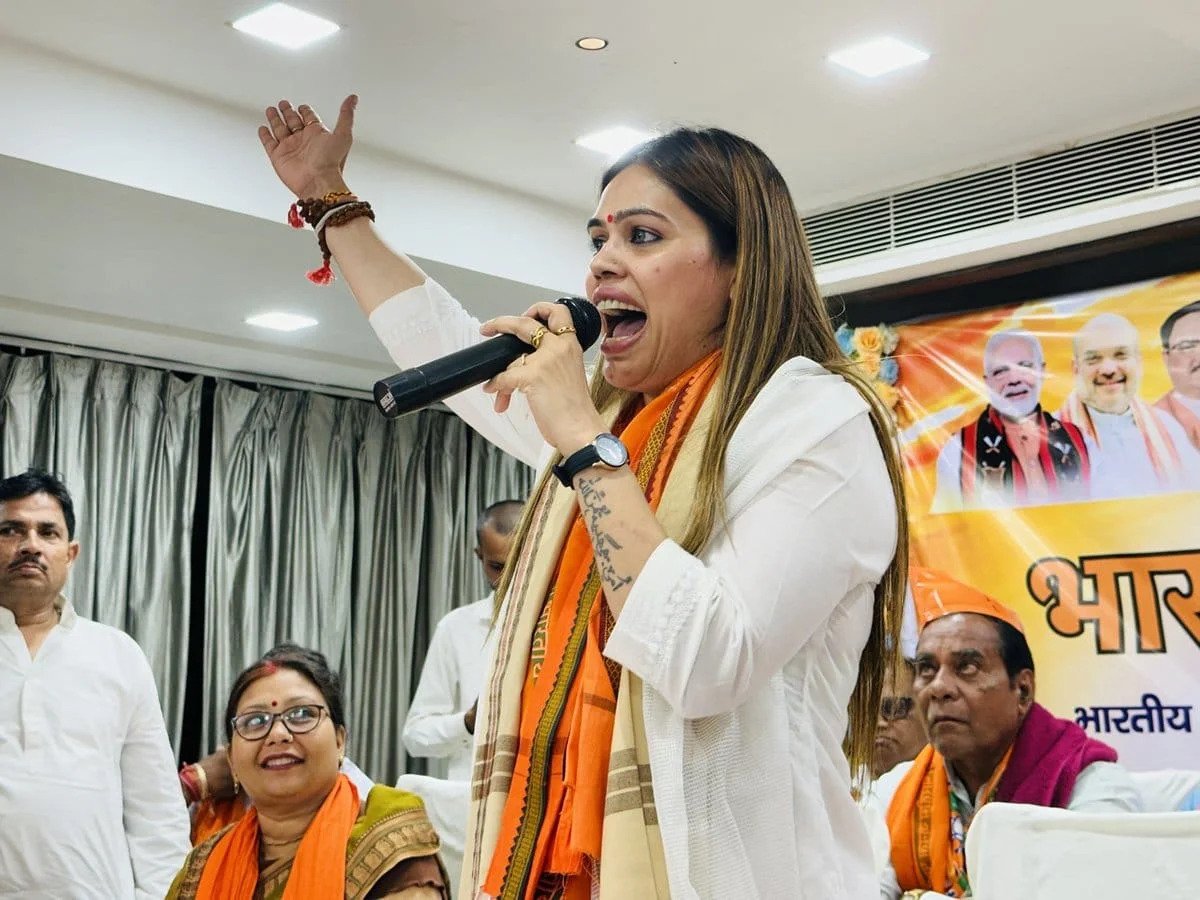
The Supreme Court on Monday declined to urgently hear a public interest litigation (PIL) seeking action over alleged derogatory remarks against Prophet Muhammad made by Nazia Elahi Khan, who identifies herself as a BJP Minority Morcha leader. A Bench of Justices Ahsanuddin Amanullah and Sheel Nagu advised the petitioner to first approach the police, observing that the issue was “very grave” but should follow the legal procedure prescribed by law.
The petition, mentioned orally before the Court, argued that Khan’s alleged remarks had the potential to disturb communal harmony across the country.
Court: Follow due process before approaching Supreme Court
Questioning the petitioner for directly approaching the apex court, Justice Amanullah asked whether any complaint had been filed before the police.
“So you file a PIL? Why come here? Have you filed a complaint with the police? Have faith in the system,” the judge remarked.
The Bench emphasised that the Supreme Court functions as the apex constitutional forum and cannot replace statutory authorities responsible for investigating cognisable offences.

“It is also an eye-opener for us whether our lower functionaries are working or not. If everything is short-circuited here, they will also raise hands… all institutions are going haywire because everything comes from the top,” Justice Amanullah observed.
The Court further cautioned lawyers against sensationalising such matters, saying that individuals accused of wrongdoing should be proceeded against “with the full force of the law” through established legal mechanisms.
“If procedure fails, come to us”
While acknowledging the seriousness of the allegations, Justice Amanullah reiterated that legal remedies must first be exhausted before invoking the Supreme Court’s jurisdiction.
“It’s a grave thing, I agree with you… I am very sensitive to it. But then there is a procedure. If that doesn’t work, come to us,” the judge said.
The Bench also observed that bypassing lower authorities weakens institutional functioning and undermines the legal process.

Controversy over alleged remarks
The controversy stems from an Instagram podcast clip uploaded around June 19, 2026, in which Nazia Elahi Khan allegedly made derogatory remarks about Prophet Muhammad and members of his family during a conversation with podcast host Divya Singh.
The video quickly circulated on social media, triggering protests and complaints from members of the Muslim community across several states.
Several Muslim organisations, including the Raza Academy, alleged that the remarks deeply hurt religious sentiments and demanded criminal action.
Khan has reportedly claimed that viral clips circulating online were AI-generated and not authentic recordings of her remarks.
Multiple FIRs and complaints across states
Following the circulation of the video, multiple criminal complaints and FIRs were registered against Khan.

The first FIR was lodged at Shanti Nagar Police Station in Bhiwandi, Maharashtra, on June 22 after a complaint by local resident Adnan Ansari. Police invoked provisions relating to deliberate acts intended to outrage religious feelings along with relevant provisions of the Information Technology Act.
A second “Zero FIR” was subsequently registered at JJ Marg Police Station in Mumbai, with police indicating that the case could be transferred to West Bengal, where Khan resides.
Additional complaints have reportedly been filed in Malegaon, Hyderabad, Uttar Pradesh, Madhya Pradesh and Rajasthan. In several districts, Muslim organisations submitted memoranda demanding criminal action against Khan.
BJP Minority Morcha distances itself
Amid the growing controversy, the BJP Minority Morcha publicly distanced itself from Khan.
In a statement issued on June 24, National President Jamal Siddiqui clarified that Nazia Elahi Khan does not hold any official position within the BJP Minority Morcha and that any claim to represent the organisation in that capacity is “false and misleading.”
Previous arrest in cheating case
Khan was previously arrested by Kolkata Police in August 2021 in connection with allegations of cheating, impersonation and criminal intimidation.
According to the investigation, she allegedly accepted ₹6 lakh from a complainant by claiming that her political and legal connections could secure a favourable outcome in an ongoing matrimonial dispute. Investigators alleged that when the promised result did not materialise and the complainant sought a refund, Khan allegedly resorted to intimidation.
She was granted bail in September 2021.
Earlier controversial statements
Over the past few years, Khan has repeatedly courted controversy through speeches and public appearances.
She has publicly promoted conspiracy theories such as “Love Jihad” and “Ghazwa-e-Hind”, questioned the patriotism of Indian Muslims, and called for an economic boycott of Muslims. In June 2026, she also drew criticism after urging Hindus to refrain from employing Muslims in both government and private sectors.

Her speeches have attracted criticism from civil rights groups, which have documented multiple instances of alleged hate speech.
Legal framework governing hate speech
Indian law criminalises speech intended to promote enmity between religious communities, outrage religious feelings, or incite violence.
The Supreme Court has repeatedly directed police authorities to register suo motu FIRs in appropriate hate speech cases without waiting for private complaints. In Shaheen Abdulla v. Union of India and subsequent orders, the Court emphasised that law enforcement agencies have a constitutional obligation to act promptly against hate speech irrespective of the identity or religion of the speaker.
The Court has also directed state authorities to take preventive measures during public events to ensure that speeches likely to incite communal hatred are promptly addressed through legal action.