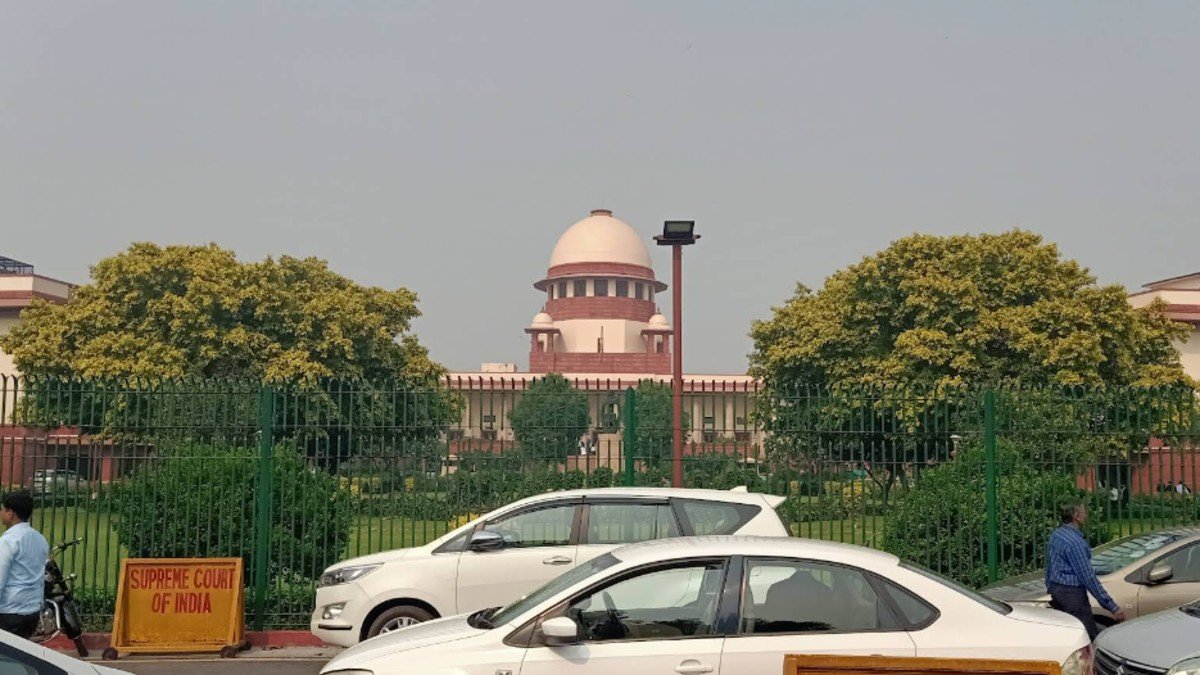
The Supreme Court on Wednesday dismissed a public interest litigation (PIL) seeking directions to stop the circulation of derogatory remarks made by influencer Nazia Elahi Khan against Prophet Muhammad, observing that such matters should first be addressed through the legal remedies already available under the law.
A bench of Justice P.S. Narasimha and Justice Alok Aradhe refused to entertain the petition under Article 32 of the Constitution, saying the extraordinary jurisdiction of the Supreme Court cannot be directly invoked in such cases.
During the hearing, Justice Narasimha orally remarked, “We understand. These Article 32 petitions are to serve something else,” indicating that the court was not inclined to hear the matter as a writ petition.
Court Questions Direct Approach to Supreme Court
Appearing for the petitioner, Advocate Pulkit Agarwal argued that the case was not about censorship but about regulating harmful content circulating on social media.
“This is about certain remarks made in a podcast hurting a particular religious community. What we are currently seeking essentially is that there is no censorship on social media. Constitutional silence is there. This Court has to determine it at some stage. Pan-India people are making podcasts and reels,” he submitted.
The bench, however, said that the petitioner should make use of the legal mechanisms already available instead of directly approaching the apex court.
Justice Aradhe asked whether the petitioner was aware of the Information Technology (Procedure and Safeguards for Interception, Monitoring and Decryption of Information) Rules, 2009, suggesting that grievances relating to online content could be addressed under the existing legal framework.
The bench also observed that filing such petitions appeared to be an attempt to “sensationalise” the issue.
Petition Sought Guidelines for Religious Content Online
The PIL was filed by Mohd. Anas Chaudhary through advocate-on-record Ansar Ahmad Chaudhari after a podcast clip allegedly containing objectionable remarks against Prophet Muhammad went viral on social media in June. Multiple FIRs were later registered against influencer Nazia Elahi Khan over the comments.
The petition sought directions to the Centre to frame guidelines regulating content that is deliberately offensive or insulting towards revered religious figures, including Prophet Muhammad and Bhagwan Shri Ram.

It also requested the court to direct authorities to identify and remove videos and social media posts containing the alleged remarks from platforms such as YouTube, Facebook, Instagram and X, arguing that such content could hurt religious sentiments and disturb communal harmony.
The Union Ministry of Home Affairs, the Ministry of Electronics and Information Technology (MeitY), YouTube, Facebook, X and Nazia Elahi Khan were made respondents in the case.
Supreme Court Reiterates Earlier Stand
This is the second time the Supreme Court has declined to intervene in the matter.
Earlier, on July 7, a vacation bench headed by Justice Ahsanuddin Amanullah had refused to grant an urgent hearing, advising the petitioner to first approach the police and follow the normal legal process.
At that time, Justice Amanullah had said, “The police are there. Have faith in our system. We are only the apex; we are here to monitor.”
The court had stressed that complainants should first exhaust the remedies available under law and could approach the Supreme Court only if those mechanisms failed.
With Wednesday’s order, the Supreme Court reaffirmed that disputes relating to allegedly offensive online content should first be dealt with under existing statutory procedures rather than through direct petitions under Article 32 of the Constitution.