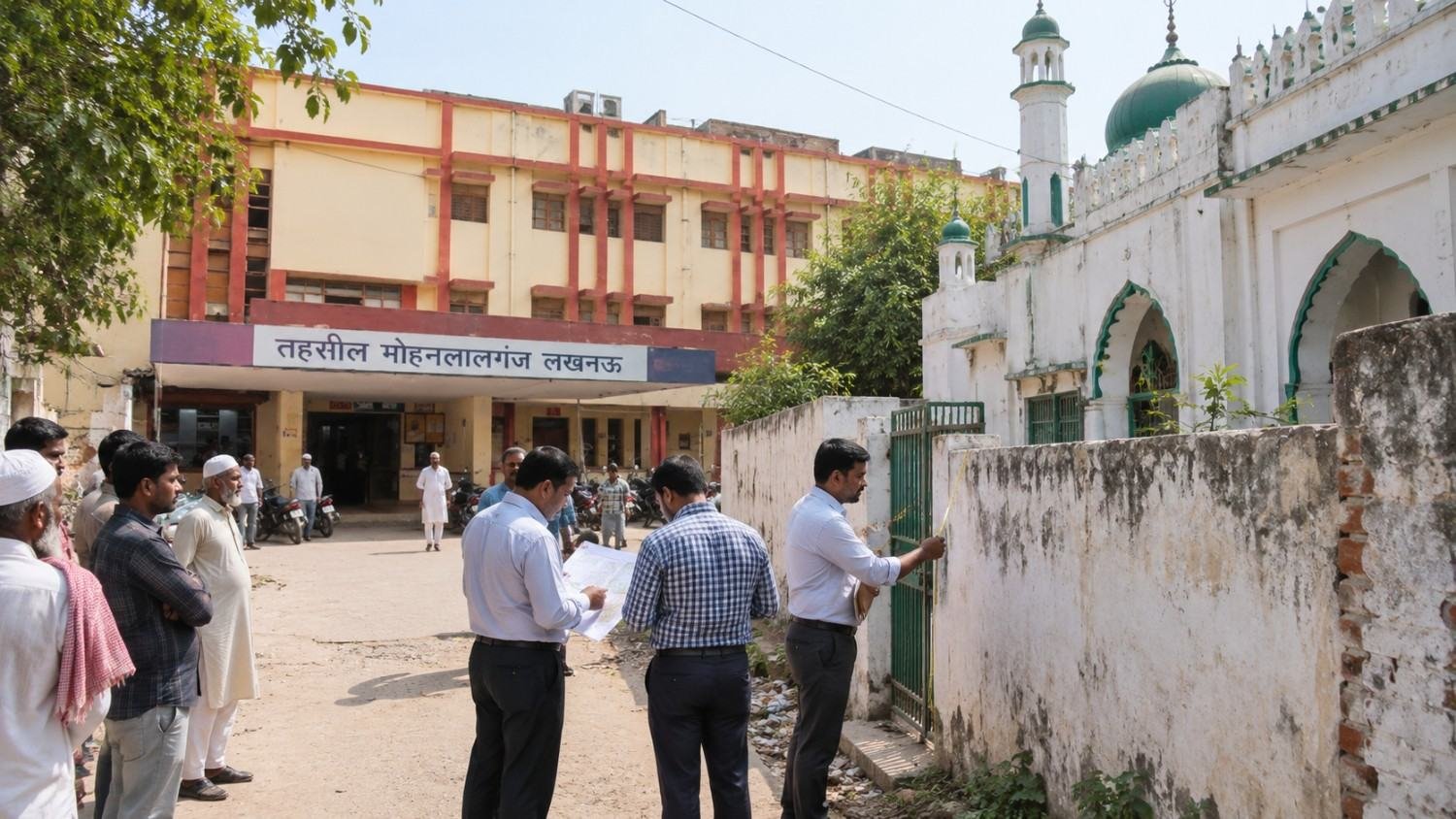
The Supreme Court on Monday upheld eviction orders concerning 3.93 acres of land belonging to the Arulmigu Annamalainathar Temple in Kadayanallur, Tamil Nadu. The disputed land had residential houses, a mosque and an Arabic school after the property was transferred to private individuals.
A Bench of Justices Aravind Kumar and Vipul M Pancholi refused to interfere with a December 2025 judgment of the Madras High Court, which had found serious irregularities in the original auction of the temple property.
Dispute Over Temple Land
The dispute dates back more than three decades. In 1994, the Tamil Nadu Temple Administration Board permitted the sale of the 3.93-acre property through a public auction, fixing the upset price at ₹3.10 lakh.
The auction was conducted on June 19, 1995, with five people participating. R Subramanian, the nephew of then hereditary trustee V Subramaniya Iyer, emerged as the highest bidder after offering ₹10.17 lakh.
The Madras High Court later found that the auction process had not followed the required legal procedure. It noted that objections under Section 34 of the Tamil Nadu Hindu Religious and Charitable Endowments Act, 1959, were invited only after the auction had already taken place.

One of the objections also questioned whether the auction valuation was significantly lower than the property’s market value.
The HR&CE Commissioner cancelled the auction proceedings in 1997. However, the Tamil Nadu government issued a Government Order in 2002 directing that the sale be implemented.
Land Sold to Over 100 People
The property was subsequently divided and sold to several people. According to an affidavit filed by hereditary trustee S Vaidyanathan in the earlier High Court proceedings, the original auction purchaser sold the land to 13 people in 2004.
Those purchasers later divided the property into plots and sold them to more than 100 people. Several buyers subsequently built houses on the land.
The affidavit also stated that a mosque and an Arabic school run by the local Muslim Jamat had been constructed on portions of the disputed property.

The surrounding streets were also described in court records as being largely inhabited by members of the Muslim community.
High Court Finds Auction Irregular
The HR&CE Department later began eviction proceedings against occupants under Section 78 of the Tamil Nadu Hindu Religious and Charitable Endowments Act.
A status report submitted before the High Court stated that there were 83 encroachers and eviction orders were eventually issued against all of them.
Initially, notices were served on 81 occupants, giving them the option of becoming tenants of the temple or handing over vacant possession.
The High Court was later informed that all 81 occupants had agreed to become tenants. The HR&CE Department subsequently began the process of determining rent and regularising their occupation under Section 34A of the Act.
In its December 2025 judgment, the Madras High Court held that the original auction was affected by “gross non-compliance” with statutory requirements and possible collusion involving the then trustee.
The court stressed that the interests of the temple and the deity would take priority over private interests created through an improperly conducted sale.
Supreme Court Refuses to Interfere
The Supreme Court’s decision means the Madras High Court judgment and the consequential proceedings concerning the temple property remain in force.
The petitioners were represented by Senior Advocates Huzefa Ahmadi and Sanjay Hegde. The respondents were represented by Senior Advocates CS Vaidyanathan, Dama Seshadri Naidu and V Chitambaresh, along with advocates G Balaji, Niranjan Rajagopalan, Abhinav Parthasarathy and NC Vishal.