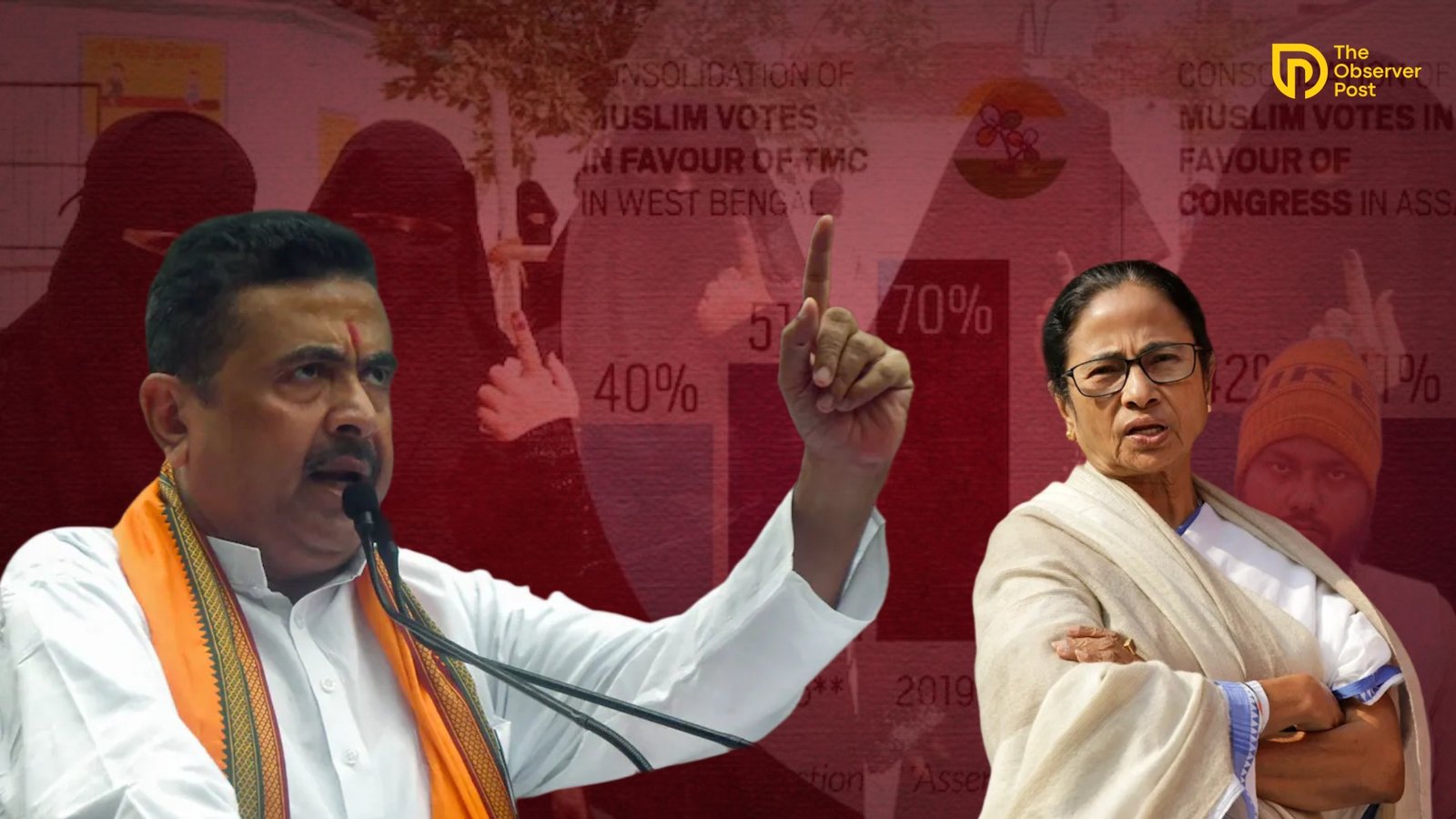
In a political earthquake that has redefined the electoral landscape of West Bengal, the 2026 Assembly election results have shattered the long-standing “vote bank” monolith. For the first time since Independence, the minority community—historically the bedrock of the All India Trinamool Congress (TMC) and the Left before it—has seen a profound fragmentation, enabling the Bharatiya Janata Party (BJP) to secure a historic mandate.
According to data released following the Monday count, the BJP has surged to 207 seats in the 294-member assembly, comfortably crossing the majority mark. Meanwhile, the TMC, which dominated the state for 15 years, saw its tally plummet to approximately 80 seats.
The Collapse of the Minority Vote Consolidation
The 2011 census established that Muslims constitute roughly 27% of West Bengal’s population, with a decisive influence in approximately 143 constituencies. While the TMC had strategically positioned itself as the sole “anti-BJP force” to consolidate this demographic, the 2026 results reveal a departure from this trend.
In former TMC bastions like Murshidabad, Malda, and South 24 Parganas, the minority vote was split among several players, including the Indian National Congress, Communist Party of India (Marxist), Indian Secular Front (ISF), and the newly formed Aam Janata Unnayan Party (AJUP).
Murshidabad and Malda Signal a Major Shift
The most dramatic shifts occurred in the minority-heavy heartlands.

In Murshidabad district, where the TMC won 20 out of 22 seats in 2021, the party was reduced to just 9 seats. The BJP wrested 6 of these, while others went to the Congress and AJUP.
In Malda, of the 12 seats, the TMC’s count fell to 6, with the BJP gaining ground in areas previously thought impenetrable.
Humayun Kabir, the AJUP founder and former TMC MLA, emerged as a giant-killer. He won Rejinagar by over 58,000 votes and Nowda by over 27,000 votes, pushing the TMC to a humiliating third place behind the BJP in both seats.
Fragmented Opposition Helped BJP Expand
Political analysts suggest this shift represents both a psychological and strategic change among voters.
“For the first time in the history of Bengal since independence, the minority community has not voted collectively,” noted political analyst Udayan Banerjee.
The division of votes often acted as a mathematical catalyst for BJP victories in organizationally weak areas. In Kandi, the BJP won by a margin of 10,000 votes after the Congress and All India Majlis-e-Ittehadul Muslimeen collectively polled over 54,000 votes.
In Beldanga, BJP’s Bharat Kumar Jhawar secured a victory by 13,000 votes, while the combined vote share of Congress and AJUP reached a staggering 86,000.
In Domkal, a traditional Left-Congress stronghold, the CPI(M) staged a resurgence with 1,07,882 votes, while the TMC followed with 91,586. This triangular contest effectively diluted the anti-BJP vote share.
Local Leadership and Changing Priorities
Sabyasachi Basu Roy Chowdhury observed that while local leaders like Humayun Kabir held their ground, a significant portion of the vote in Malda and Murshidabad returned to the Congress, indicating that voters are increasingly prioritizing “local stability over statewide integration.”
Meanwhile, Imran Zaki described the moment as a turning point.

“The BJP is going to form a new government in Bengal. For Muslims and other minority communities, this should be a time of participation, not fear,” he said.