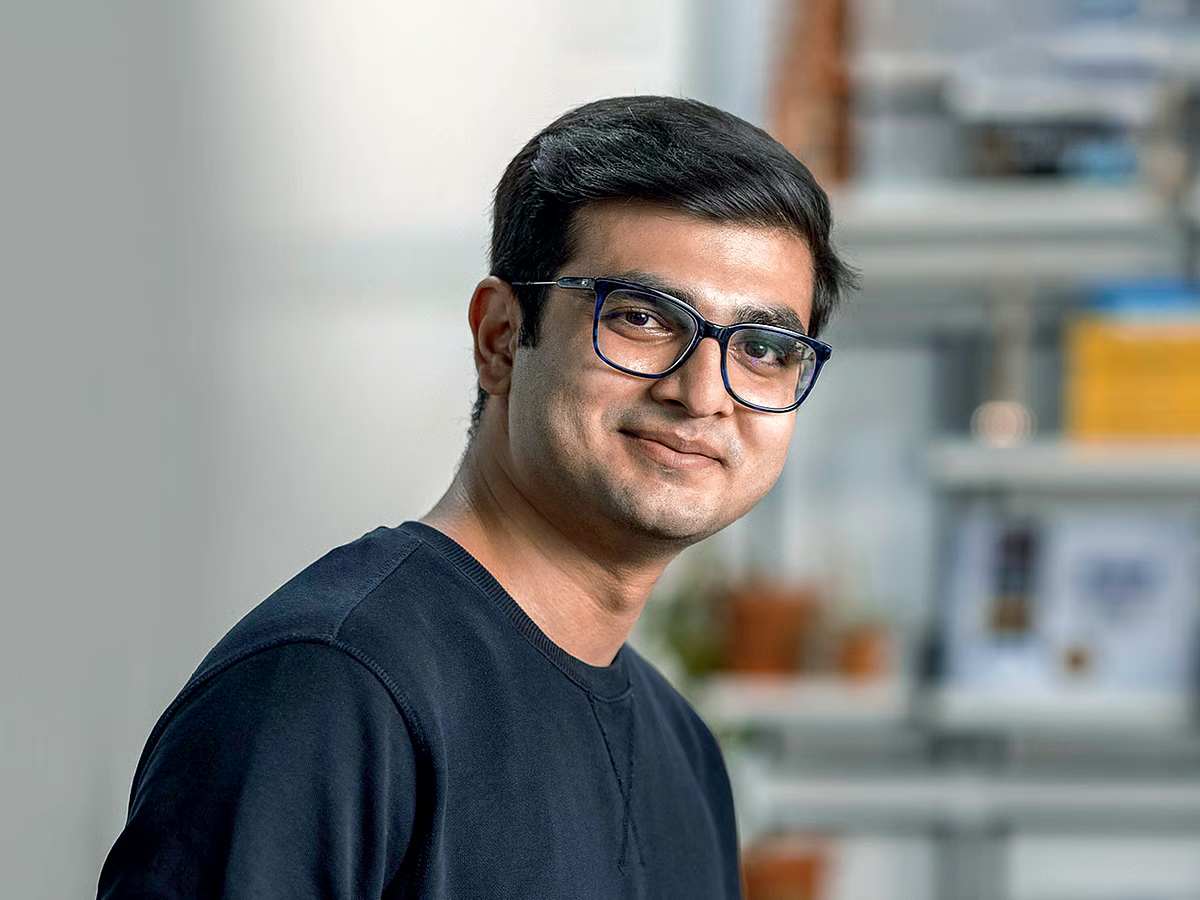
Awais Ahmed grew up in Aldur, a village in Karnataka’s Chikkamagaluru district, without a smartphone or internet connection. His early understanding of science and space came from printed encyclopedias his father brought home, which he read under candlelight. He did not get access to the internet until Class 8.
Today, Ahmed is the founder and chief executive of Pixxel, a Bengaluru and Los Angeles-based space technology company that has raised $95 million — approximately ₹900 crore — from investors including Google, Lightspeed Venture Partners, and Radical Ventures, and holds contracts with the United States’ NASA and National Reconnaissance Office.
The Problem That Started It All
Ahmed’s path to space entrepreneurship began not with a grand vision but with a practical challenge. In 2018, while competing in the IBM Watson AI Challenge as a final-year student at BITS Pilani, he and his classmate Kshitij Khandelwal attempted to build an artificial intelligence model to track crop health across large agricultural areas. To do so, they needed satellite imagery — and found that the imagery available to them was of insufficient resolution and spectral range to detect early-stage crop stress, methane emissions, or chemical contamination in soil and water.
Rather than changing the project, the two students decided to build their own satellite system. “We saw that the world needed a health monitor for the planet,” Ahmed has said in past interviews, “and that the data to build it simply didn’t exist.”
Founding Pixxel

In February 2019, while still completing their degrees, Ahmed and Khandelwal incorporated Pixxel with initial capital of approximately ₹10,000 per month, borrowed from Ahmed’s father. The company’s founding purpose was to build and deploy hyperspectral imaging satellites — a technology that captures data across hundreds of narrow wavelengths of light, including ranges invisible to the human eye, and can detect chemical, biological, and physical changes in the earth’s surface that conventional optical satellites cannot.
This is distinct from standard satellite photography. Traditional remote sensing satellites capture broad colour bands — typically red, green, and blue — sufficient for visual mapping but inadequate for identifying early crop disease, tracking forest carbon stock, detecting pipeline leaks, or monitoring industrial pollution. Pixxel’s hyperspectral approach analyses more than 250 spectral bands per image, allowing clients to identify, track, and quantify such phenomena in close to real time.
The Firefly Constellation
In 2025, Pixxel successfully deployed its Firefly constellation of six hyperspectral satellites. The constellation is described by the company as among the most advanced commercial hyperspectral imaging networks currently in orbit. Ahmed says Pixxel’s data is now used across sectors including precision agriculture, oil and gas monitoring, environmental compliance, forestry, and national security.
Pixxel became the first Indian space startup to secure a commercial contract with NASA, and subsequently signed a five-year data supply agreement with the US National Reconnaissance Office — an intelligence agency that manages the United States’ classified satellite surveillance infrastructure.
Ahmed has been named to Forbes 30 Under 30 and MIT Innovators Under 35. He completed his undergraduate degree in Mathematics at BITS Pilani, where he also served as engineering lead for Hyperloop India, the student team that reached the finals of the SpaceX Hyperloop Pod Competition in California, and participated in Team Anant, a student satellite programme conducted in partnership with the Indian Space Research Organisation.
Pixxel operates offices in Bengaluru and Los Angeles. Ahmed splits his time between the two cities. The company employs engineers across both locations and counts several former ISRO scientists among its technical staff.