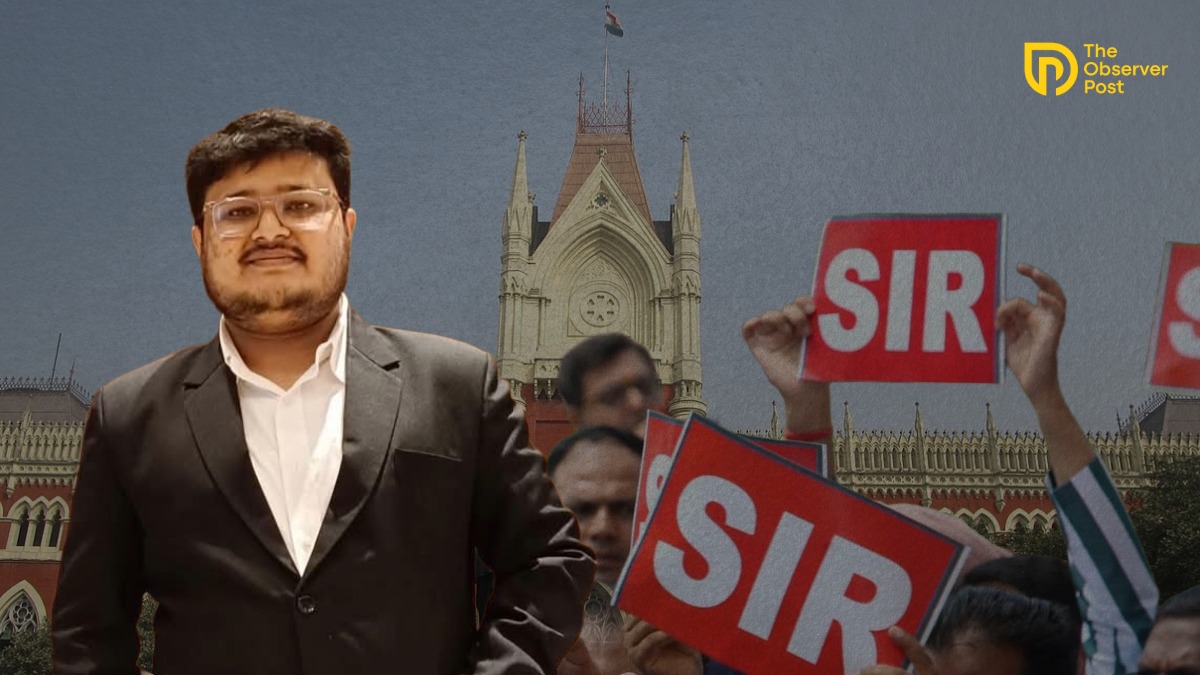
Raising serious concerns over the ongoing Special Intensive Revision (SIR) of electoral rolls in West Bengal, advocate Asfak Ahammed, an advocate of the Calcutta High Court, has written to the Chief Justice seeking urgent judicial intervention.
In his letter, Ahammed invoked the extraordinary jurisdiction of the High Court, describing the matter as one of “grave public importance” affecting lakhs of citizens across the state. He alleged that the SIR process—ostensibly aimed at preparing an error-free electoral roll—has led to the large-scale deletion of names of genuine voters on what he termed vague and undefined grounds such as “Logical Discrepancy.”
According to the advocate, the current exercise raises serious constitutional concerns, particularly under Articles 14 and 21 of the Constitution of India, which guarantee equality before law and protection of life and personal liberty.
Constitutional Concerns
Ahammed outlined a series of procedural and legal deficiencies in the ongoing revision process. Among the most significant concerns is what he described as the arbitrary application of the term “Logical Discrepancy.” He stated that minor variations in spelling, use of prefixes or suffixes, and changes in surnames—especially in the case of married women—are being treated as grounds for deletion of voter names.
He cited the recent judgment of the Md. Rahim Ali @ Abdur Rahim vs State of Assam & Ors., where the Supreme Court of India held that such minor discrepancies should not result in adverse civil consequences.

The advocate further alleged a complete breakdown of procedural fairness. He claimed that affected individuals are not being informed of specific allegations against them, while notices issued are vague and hearings conducted in a perfunctory manner. “No reasoned orders are supplied,” he noted, terming the process a violation of the principles of natural justice.
Appeal Mechanism Under Scrutiny
Another major concern raised in the letter pertains to the lack of transparency and functionality in the appellate system. Although an appeal to a tribunal is reportedly available within 15 days, Ahammed claimed that the tribunal mechanism is neither properly constituted nor governed by clear procedures.
He also pointed to serious limitations in the online appeal system, including the inability to upload supporting documents and restrictive character limits for submissions. According to him, these constraints make it nearly impossible for individuals to effectively present cases involving complex questions of identity and lineage.
Impact on Marginalized Communities
Highlighting the social implications, Ahammed argued that the SIR process disproportionately affects poor, rural, and marginalized communities, including women, who may lack the resources or documentation required to navigate such procedures.
He further warned that the reliance on historical electoral rolls—particularly those from 2002—and insistence on documentary proof effectively transforms the electoral revision exercise into a “de facto citizenship verification process” without any statutory mandate.

Call for Judicial Intervention
Describing the situation as urgent and potentially irreversible, Ahammed urged the High Court to take suo motu cognizance or treat his letter as a Public Interest Litigation (PIL). He sought an immediate stay on arbitrary deletions based on “Logical Discrepancy” and called for directions to authorities to provide detailed, reasoned orders to affected individuals.
Additionally, he requested the Court to ensure that the appellate mechanism is made functional, transparent, and compliant with principles of natural justice.
“This issue concerns not merely administrative irregularity but the very foundation of democratic participation,” Ahammed stated in his letter.