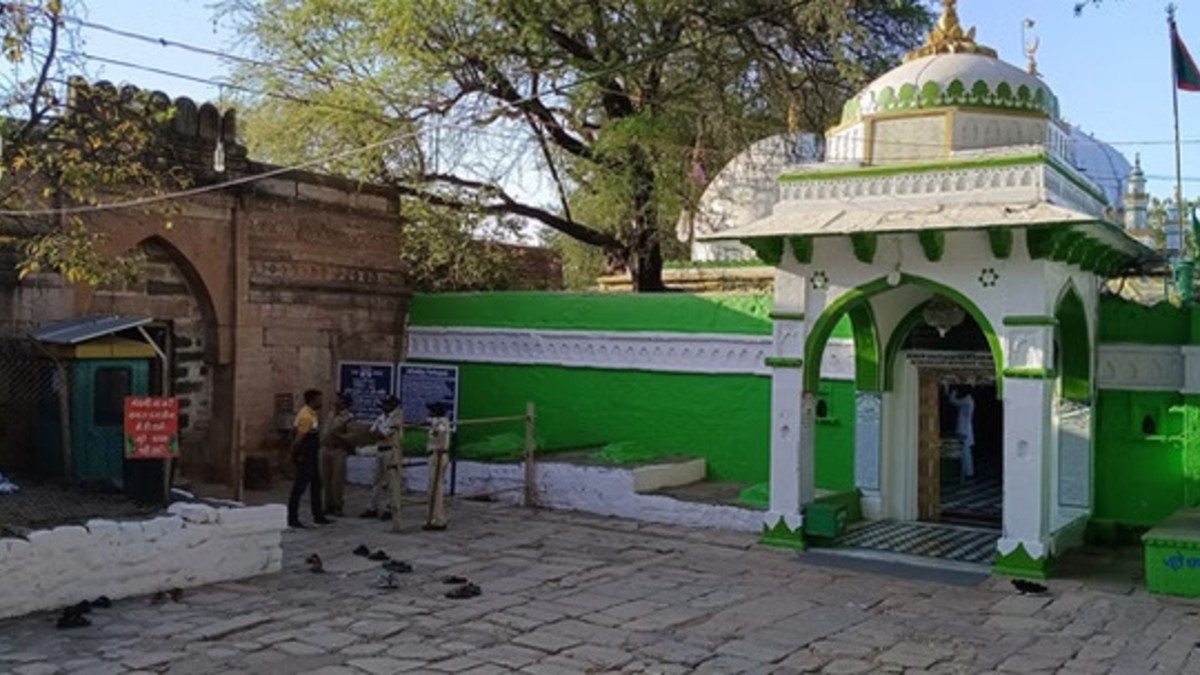
Hindu devotees began offering prayers at the disputed Bhojshala-Kamal Maula Mosque complex in Madhya Pradesh’s Dhar district on Saturday, a day after the Indore bench of the Madhya Pradesh High Court declared the site a temple dedicated to Goddess Saraswati and ended the arrangement that allowed Muslims to offer Friday namaz there.
The court’s decision led to celebrations among Hindu groups, with devotees gathering at the Bhojshala premises to perform prayers and recite the Hanuman Chalisa under heavy police security.
A devotee present at the site said people were emotional after the ruling.
“We are delighted that we were able to have darshan, and there was no fee, unlike previous times. Now the entire Hindu society can conduct pooja every day. We are elated after yesterday’s verdict, and all of us were crying and dancing with joy,” the devotee said.
Authorities deployed around 1,200 police personnel in and around the complex to maintain law and order.
What Did the Madhya Pradesh High Court Say?
In a 242-page judgment delivered on May 15, the Indore bench of the Madhya Pradesh High Court ruled that the religious character of the Bhojshala-Kamal Maula Mosque complex is that of a temple dedicated to Goddess Vagdevi (Saraswati).
The bench of Justices Vijay Kumar Shukla and Alok Awasthi relied heavily on the Archaeological Survey of India’s (ASI) scientific survey report, which was conducted over 98 days in 2024. The report suggested that a large temple-like structure dating back to the Parmar dynasty existed at the site before later modifications.
“The religious character of disputed area of the Bhojshala Complex and Kamal Maula Mosque is held to be a Bhojshala with a temple of goddess Vagdevi (Saraswati),” the court said.
The court also cancelled parts of the ASI’s April 7, 2003 order, which had allowed Hindus to worship on Tuesdays and Muslims to offer namaz on Fridays at the ASI-protected monument.
Hindu Side Calls Verdict ‘Historic’
Advocate Vishnu Shankar Jain, representing the Hindu side, described the judgment as a “historic verdict” and said Hindus would immediately begin exercising their right to worship at the complex.
“We will worship in the premises in question. We will exercise our fundamental rights of worship in the premises in question in tune with Article 25, as well as Section 16 of the ASI Act 1958,” Jain said.
He also said the Hindu side would defend the verdict if challenged in the Supreme Court.
“And in case the Muslim petitioners approach the honourable Supreme Court by way of an SLP, we will also file our caveat and present our arguments before the court,” he added.
Jain further welcomed the court’s observation asking the government to consider representations for bringing back the idol of Goddess Saraswati currently housed in a London museum.
Muslim Organisations to Challenge Verdict in Supreme Court
Muslim organisations and leaders criticised the ruling and said they would challenge it in the Supreme Court.
Advocate Noor Ahmed Sheikh, representing the Muslim side, confirmed that they would move the apex court against the judgment.
Meanwhile, AIMIM chief Asaduddin Owaisi criticised the ruling, saying it ignored constitutional principles and the Places of Worship Act.
“We consider this judgment erroneous because the Court ignored the 1935 Dhar State Gazette, 1985 Waqf registration, and also ignored the Places of Worship Act,” Owaisi said.
He compared the ruling to the Babri Masjid case and warned that it could trigger similar disputes at other religious sites.
“This judgment has turned out to be exactly like the Babri Masjid case,” he said.
Court Suggests Alternative Land for Mosque
The High Court also observed that if the Muslim community seeks land elsewhere in Dhar district for constructing a mosque, the Madhya Pradesh government may consider the request.
The long-running dispute over the Bhojshala complex has remained contentious for years, with Hindus claiming it as a temple dedicated to Goddess Saraswati and Muslims identifying it as the Kamal Maula Mosque. A Jain group has also claimed the structure was originally a Jain temple and educational centre.