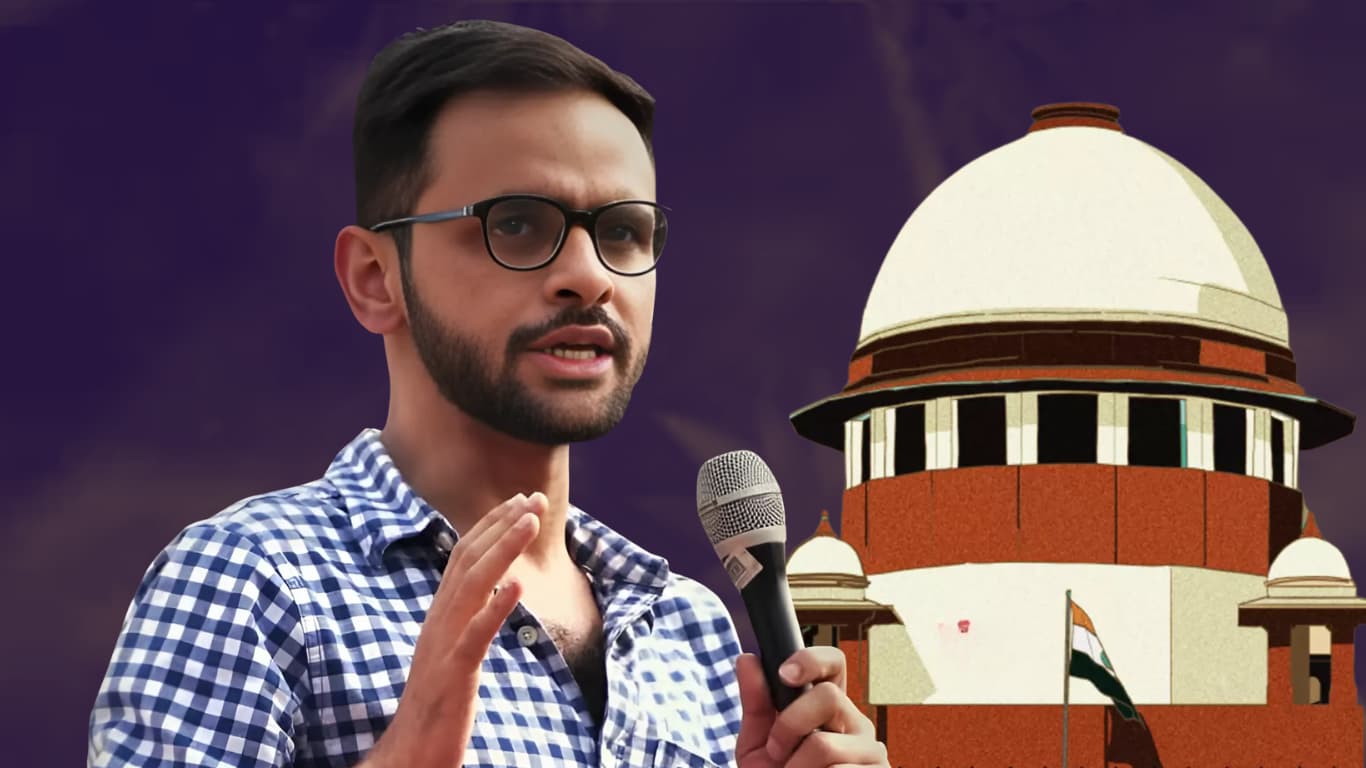
The Supreme Court on Monday raised serious reservations about an earlier judgment that denied bail to activist Umar Khalid in the Delhi riots larger conspiracy case, saying a two-judge bench could not ignore binding legal principles laid down by a larger bench on bail in cases under the Unlawful Activities (Prevention) Act (UAPA).
A bench of Justice B V Nagarathna and Justice Ujjal Bhuyan made the observation while granting bail to Syed Iftikhar Andrabi, a Jammu and Kashmir resident who has spent over six years in jail in a UAPA case linked to alleged terror funding through narcotics.
The court said the 2021 ruling in the case of Union of India vs KA Najeeb by a three-judge bench clearly recognised prolonged delay in trial as a valid ground for granting bail, even under the strict provisions of the UAPA.
Court Questions Gulfisha Fatima Judgment
The bench expressed concern over the January 2026 judgment in Gulfisha Fatima vs State, which denied bail to Umar Khalid and Sharjeel Imam in the Delhi riots conspiracy case.
“We have serious reservations about the judgment in Gulfisha Fatima,” the bench said, adding that the ruling appeared to narrowly interpret the KA Najeeb verdict and weakened its constitutional importance.
Justice Bhuyan observed that a smaller bench is bound by decisions of a larger bench and cannot dilute or ignore established legal principles.
“A judgment rendered by a bench of lesser strength is bound by the law declared by the bench of greater strength. Judicial discipline mandates that such a binding precedent must either be followed or referred to a larger bench,” the court said.
The judges also questioned a separate 2024 ruling in Gurwinder Singh vs Union of India, saying it similarly failed to properly apply the KA Najeeb precedent.
‘Bail Is Rule, Jail Exception’
Reiterating a key constitutional principle, the Supreme Court said that even in UAPA cases, prolonged imprisonment without trial cannot become punishment.
“Even under the UAPA, bail is the rule and jail is the exception,” the bench said.
The court stressed that Section 43D(5) of the UAPA, which makes bail difficult in terror-related cases, cannot override the constitutional right to personal liberty and speedy trial under Article 21.
“If this interpretation is ignored, undertrial detention risks becoming a form of punishment before conviction,” the court observed.
The judges further noted that serious allegations should lead to faster trials, not endless incarceration.
“Ideally, the more serious the accusations are, the speedier the trial should be,” the bench remarked.
Bail Granted to Andrabi After Six Years in Jail
The observations came while granting bail to Syed Iftikhar Andrabi, who was arrested by the National Investigation Agency in June 2020.

The agency accused Andrabi of being part of a “cross-border narco-terror network” allegedly linked to groups including Lashkar-e-Taiba and Hizbul Mujahideen.
Despite the seriousness of the allegations, the Supreme Court said indefinite incarceration without conclusion of trial was unacceptable, especially when conviction rates in UAPA cases remain low.
Referring to crime data, the court noted that conviction rates in UAPA cases across India remain between 2% and 6%, while in Jammu and Kashmir the rate has remained below 1% in recent years.
The court granted Andrabi bail with conditions, including surrendering his passport, cooperating with the investigation, and regularly appearing before authorities.